
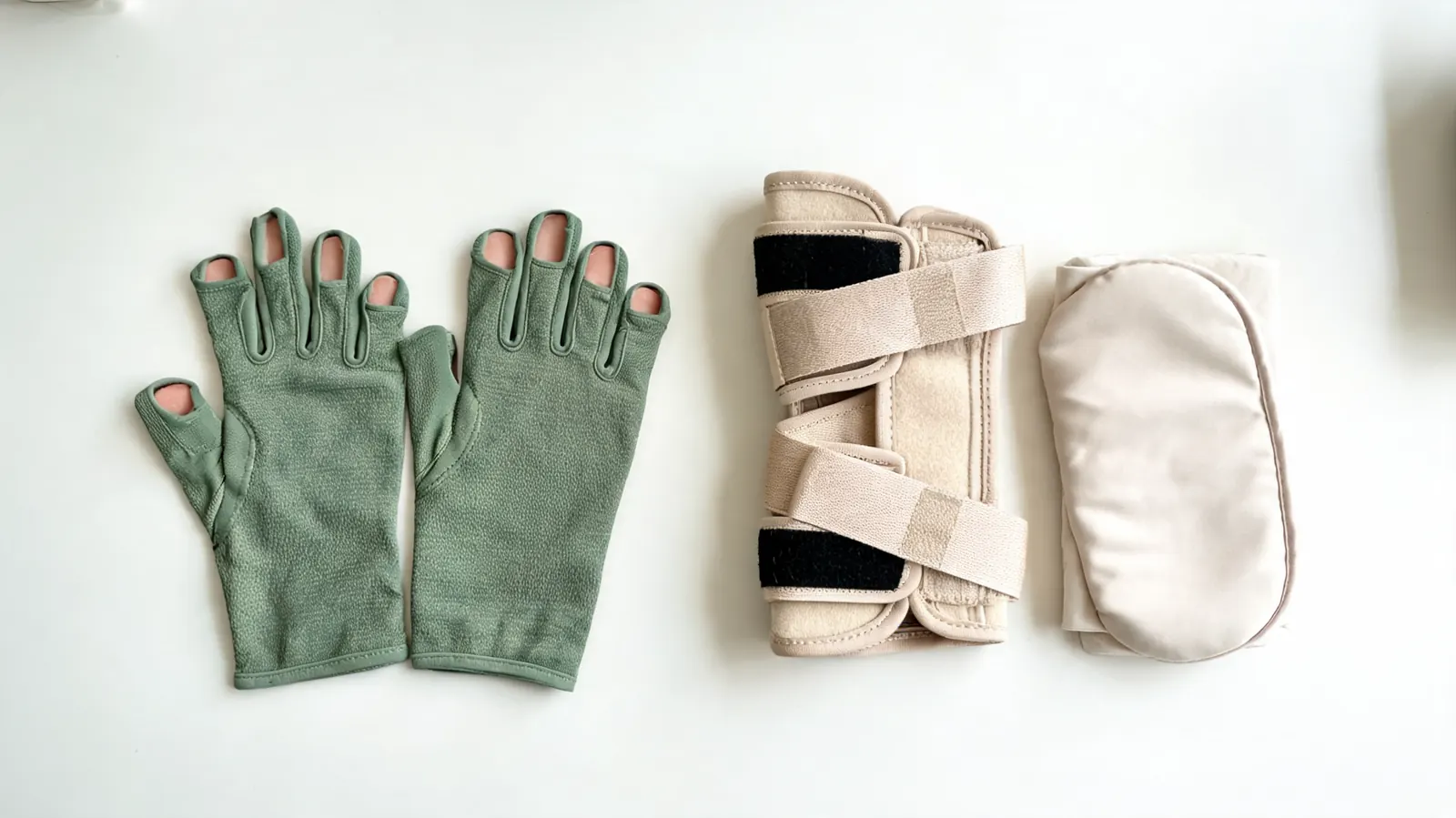
When my rheumatologist first suggested I look into hand support, she said two very different words in the same sentence: gloves and splints. She did not explain the difference. She handed me a pamphlet and moved on. I went home and spent an hour trying to figure out whether I needed the soft fabric things that look like fingerless gloves or the rigid plastic contraptions that strap your wrist at a fixed angle. If you have RA and your hands are involved, you have probably hit the same wall. This article exists to give you the clear, practical answer that pamphlet did not.
The short answer: compression gloves and hand splints are not competing tools. They do completely different things. For the majority of your waking day, compression gloves are the right call. For acute flares, severe hand involvement, and nighttime joint protection, a properly fitted wrist splint earns its place. The mistake is using one when you actually need the other. The Vive Compression Arthritis Gloves handle the daytime, functional-life side of the equation well, and at a price point that makes them easy to try.
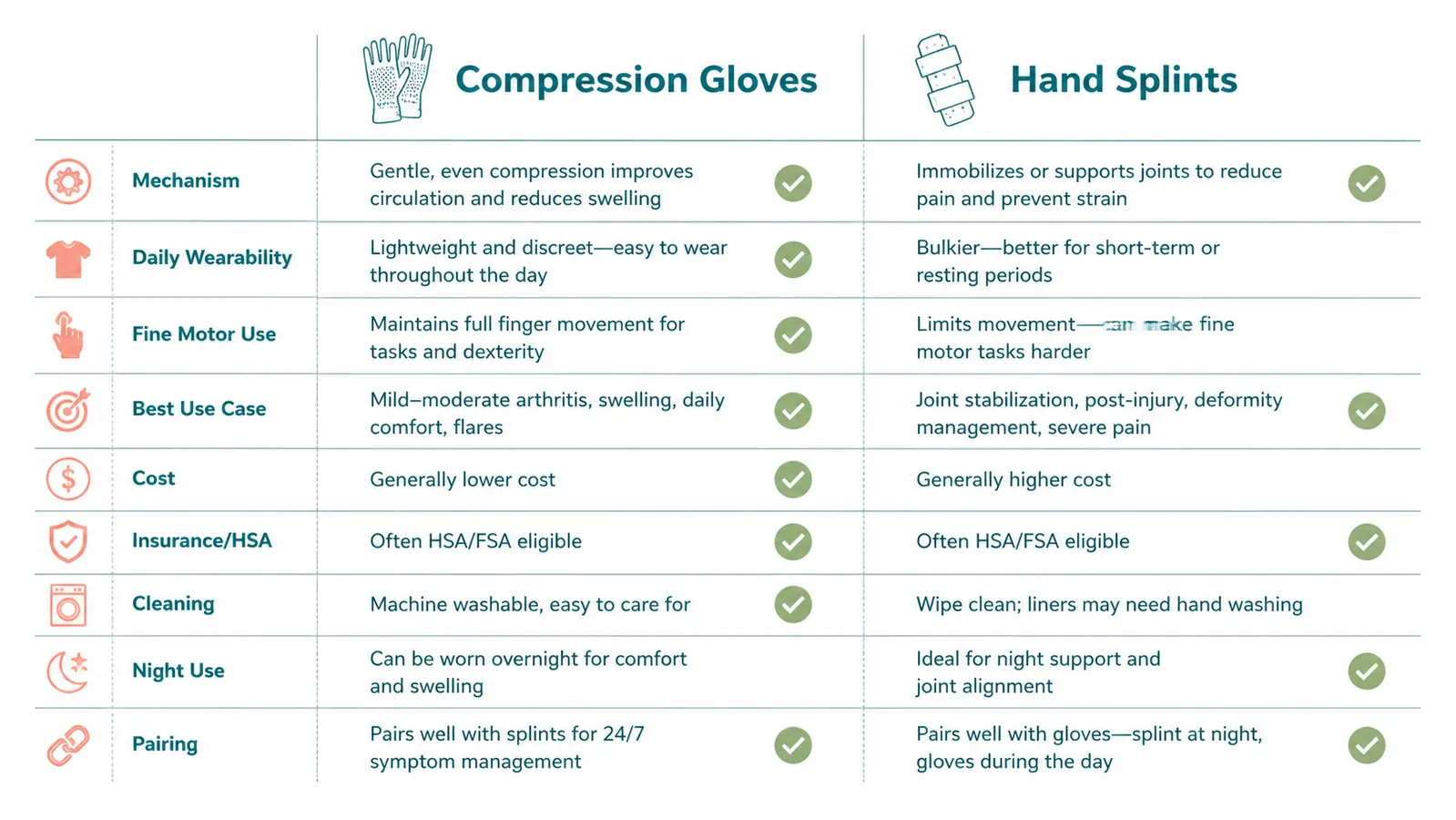
| Compression Gloves (Vive) | Hand Splints (OT-prescribed / OTC) | |
|---|---|---|
| Mechanism | Uniform warmth and graduated compression to reduce swelling and improve circulation | Rigid immobilization to restrict joint movement and prevent further injury |
| Daily Wearability | Soft, breathable fabric; can wear 6-8 hours; nearly invisible under sleeves | Rigid plastic frame with Velcro straps; bulky; visible through clothing |
| Fine Motor Function | Open finger design allows typing, writing, holding a mug, driving | Severely restricts fine motor tasks; not practical for typing or signing documents |
| Best Use Case | WFH typing, desk work, errands, mild-to-moderate daily RA hand pain | Severe RA flare, acute hand inflammation, nighttime joint protection, post-surgery |
| Cost | Budget-friendly OTC on Amazon; no prescription needed | Affordable for OTC brace; OT-custom fitted splint costs significantly more (often partly covered by insurance) |
| Insurance / HSA | HSA and FSA eligible; check your plan | HSA, FSA, and often covered by insurance as durable medical equipment when prescribed |
| Cleaning | Machine washable; air dry; replace every few months | Wipe with a damp cloth only; liner inserts may be washable separately |
| Nighttime Use | Not ideal; most people find compression during sleep uncomfortable | Resting splints are specifically designed for overnight joint protection |
| Can You Pair Both? | Yes. Gloves during the day, splint at night is a common OT recommendation | Yes. No conflict between daytime glove use and nighttime splint use |
If you spend your days typing, driving, or just trying to hold a coffee cup without wincing, start here.
The Vive Compression Arthritis Gloves are soft, open-fingered, machine washable, and HSA-eligible. They are what I reach for before I sit down at my laptop every morning. Check today's price on Amazon before your next flare hits.
Amazon Check Today's Price on Amazon → →How Each One Actually Works on Your Joints
Compression gloves work through two mechanisms working together. First, the snug elastic fabric raises the temperature of the tissue around your metacarpophalangeal joints and proximal interphalangeal joints, which is just a clinical way of saying the knuckles that RA tends to attack first. Warmth improves circulation, which helps flush out some of the inflammatory fluid that makes your joints feel like they are full of wet cement in the morning. Second, the uniform compression from the fabric provides mild proprioceptive feedback, meaning your brain gets clearer positional information about your fingers, which reduces the guarded, protective muscle tension that makes stiff hands feel even worse.
A hand splint works entirely differently. A resting wrist splint, the kind an occupational therapist typically recommends for RA, holds your wrist at a neutral angle, usually somewhere between 0 and 15 degrees of extension, while keeping the fingers in a relaxed, slightly curved position. The goal is not compression or warmth. The goal is immobilization. When your wrist and hand joints are held still during sleep, or during a severe flare, the inflammatory process cannot torque the joint into progressively worse alignment. Over time, consistent splint use during high-inflammation periods is linked to slowing the rate of joint deformity in moderate-to-severe RA. That is a real benefit. But it comes at a cost: you cannot do much of anything useful while your hand is in a rigid splint.
So these two tools are not fighting over the same job. Compression gloves are a functional tool for your working hours. Splints are a protective tool for your resting hours or your worst flare days. Understanding that distinction removes a lot of the confusion.
Where Compression Gloves Win
For the vast majority of daily life with RA, compression gloves are the more practical option by a wide margin. The Vive open-finger design in particular solves the single biggest problem with arthritis handwear: you can still use your hands. I can type a full document, sign a check, drive, peel an orange (slowly, but still), and hold a mug. None of those things are possible with a rigid splint on your dominant hand.
The wearability gap is also significant. Compression gloves go under a cardigan and no one at a work meeting knows you are wearing them. A wrist splint, even a sleek OTC version like the Mueller Fitted Wrist Brace, is visibly medical. For a lot of young RA patients, there is already an awkward conversation every time someone notices you are not quite moving your hands normally. Adding a visible brace to that equation is not always something you want to deal with on a regular Tuesday.
The cost and accessibility gap is also real. The Vive gloves are in the single-digit price range at current Amazon pricing. You can order a pair, try them for two weeks, and know whether they are helping without a significant financial commitment. A custom OT-fitted splint requires an occupational therapy appointment (with copay), a prescription in many cases, and a wait time. For mild-to-moderate daily RA hand symptoms, compression gloves are the logical first step.
Compression gloves are a tool for your working hours. Splints are a tool for your resting hours or your worst flare days. Once you understand that, the choice is obvious.

Where Hand Splints Win
There are two situations where a hand splint is clearly the right tool and a compression glove is not. The first is nighttime. During sleep, your hands rest in whatever position gravity and habit dictate, and for many RA patients, that is a curled, flexed position that keeps inflamed joints under sustained load for six to eight hours. A resting splint holds the wrist and hand in a neutral, pressure-free alignment while you sleep. This is not something a compression glove can replicate. If you are waking up with hands that take two or three hours to loosen up, and that morning stiffness is severe, your OT or rheumatologist will likely recommend a resting splint for nighttime use. That recommendation is correct.
The second situation is a severe acute flare with significant hand involvement. When your knuckles are red, hot, and visibly swollen, and you are in the kind of flare where even the weight of a sheet on your hand is painful, a compression glove is adding pressure to already inflamed tissue. That is not what you want. In that scenario, the right move is rest, ice if tolerated, medication as directed by your rheumatologist, and potentially a loosely worn resting splint to keep the joint in a neutral position during the acute phase. Ask your occupational therapist about flare-specific splint protocols. They exist and they are genuinely useful.
A third situation worth naming: post-surgical hand or wrist recovery. If you have had synovectomy, joint replacement, or tendon repair, you will likely be in a rigid cast or custom splint for a prescribed period. Compression gloves are not a substitute for post-surgical immobilization. Follow your surgeon's protocol.
The Case for Using Both (They Are Compatible)
The most common occupational therapy recommendation for patients with moderate RA and significant hand involvement is not a choice between gloves and splints. It is a protocol that uses both. Compression gloves during the day to support function and manage chronic low-level swelling. A resting splint at night to protect joint alignment during sleep. The two tools cover different hours of the day and serve completely different physiological goals. There is no conflict.
If you are newly diagnosed and trying to figure out where to start, the practical path is: order the compression gloves first. They are inexpensive, require no prescription, and give you immediate feedback within the first week of regular wear. If your morning stiffness is severe, or you are having frequent flares with acute swelling, bring that information to your next rheumatology or OT appointment and ask specifically about a resting splint for nighttime use. That conversation will go much better if you already have data from your experience with the gloves: what helped, what did not, how severe the morning stiffness actually is.
The Vive gloves in particular make a good starting point because the open-finger design works for practically every daily task, the fabric is light enough to wear for a full workday without overheating, and the fit range accommodates most hand sizes. For a full breakdown of what 9 months of daily wear actually looks like, see our long-form review at Vive Compression Arthritis Gloves: 9 Months of Daily Use With RA. And if you want a focused look at why gloves in particular matter for RA hand involvement, 10 Reasons Compression Gloves Help RA Hands covers the physiology in more detail.
What to Look For in Each Option
Not all compression gloves are equal. The most important feature for RA use is the open-finger design. Closed-finger arthritis gloves exist, but they make fine motor tasks nearly impossible and most RA patients stop wearing them within a week. The second thing to look for is fabric composition: copper-infused or pure nylon-spandex blends both work, but you want a fabric with enough elastic memory to maintain compression throughout the day without going slack. The Vive gloves use a nylon-spandex blend that holds compression reasonably well across a full workday. Machine washability is non-negotiable for something you will wear against skin every day.
For splints, fit matters significantly more than brand. An OTC wrist brace from a pharmacy or Amazon can work well for mild protection, but if your RA has caused any degree of joint deformity or if you need a splint for regular nighttime use, an OT-custom fitted splint is worth the investment. Custom thermoplastic splints are molded to your exact hand position and grip pattern, which means they actually protect the joint rather than just sitting in the right general area. Many insurance plans cover OT-prescribed splints as durable medical equipment. Call your insurance before your appointment and ask.
Pros
- Open-finger design keeps all five fingers fully functional for typing, writing, and holding objects
- Soft, breathable fabric is wearable for 6-8 hours without overheating or skin irritation
- Machine washable, which matters when you wear something against your skin daily
- Low price point makes it easy to try without a significant financial commitment
- HSA and FSA eligible
- Discreet enough to wear at work without visible medical equipment
- Available in multiple sizes; the fit guide is accurate
Cons
- Do not replace a proper resting splint for nighttime joint protection
- Not appropriate during an acute hot flare with significant swelling
- Compression relaxes somewhat by end of day; some users replace pairs more frequently than they expect
- Will not correct existing joint deformity or substitute for medical treatment
- One size does not fit all; measure your hand before ordering
Pros
- The right tool for nighttime joint protection and acute flare management
- Custom OT-fitted splints can be molded to your exact hand alignment
- Often covered by insurance as durable medical equipment when prescribed
- Rigid immobilization is the appropriate intervention for severe RA hand involvement
- Can slow the rate of joint deformity during high-inflammation periods when worn consistently
Cons
- Completely prevents fine motor function while worn; cannot type, write, or drive
- Bulky and visibly medical; difficult to wear discreetly in professional or social settings
- Custom splints require an OT appointment, prescription, and waiting period
- Cleaning is limited to wipe-down; they degrade with age
- OTC versions may not fit RA-affected hands correctly; custom fitting often necessary for real benefit
Who Should Start With Gloves, Who Needs a Splint, and Who Needs Both
If you are newly diagnosed with mild-to-moderate RA and your main complaints are morning stiffness, swelling around the knuckles, and difficulty with grip tasks during the workday, start with compression gloves. They are available today, inexpensive, require no appointment, and work for most people within the first week of consistent use. The Vive open-finger design covers most daily-life tasks. Order them, wear them for two weeks, and pay attention to what changes.
If you have moderate-to-severe RA with significant morning stiffness that lasts more than an hour, a history of acute flares with hot swollen hands, or any degree of joint deformity developing in your fingers or wrist, you need both tools and you need a conversation with an occupational therapist. An OT who specializes in hand therapy can assess your specific joint involvement, recommend the correct splint type (resting versus functional), and fit it properly. Trying to manage moderate-to-severe RA hand involvement with compression gloves alone is like trying to manage a broken ankle with a compression sock. Useful in some contexts, not sufficient for the actual problem.
If you are somewhere in the middle, which is where most young RA patients land, the practical answer is: start with gloves for daily function, bring your OT or rheumatologist in on the question of nighttime splinting, and treat the two tools as complementary rather than competing.
Three dollars a week for hands that can actually type, hold a mug, and get through a workday. Not a bad trade.
The Vive Compression Arthritis Gloves are the most practical starting point for daytime RA hand management. Open-finger, machine washable, HSA-eligible, and budget-friendly. Check today's price and see if they are still in stock before your next flare day.
Amazon Check Today's Price on Amazon → →