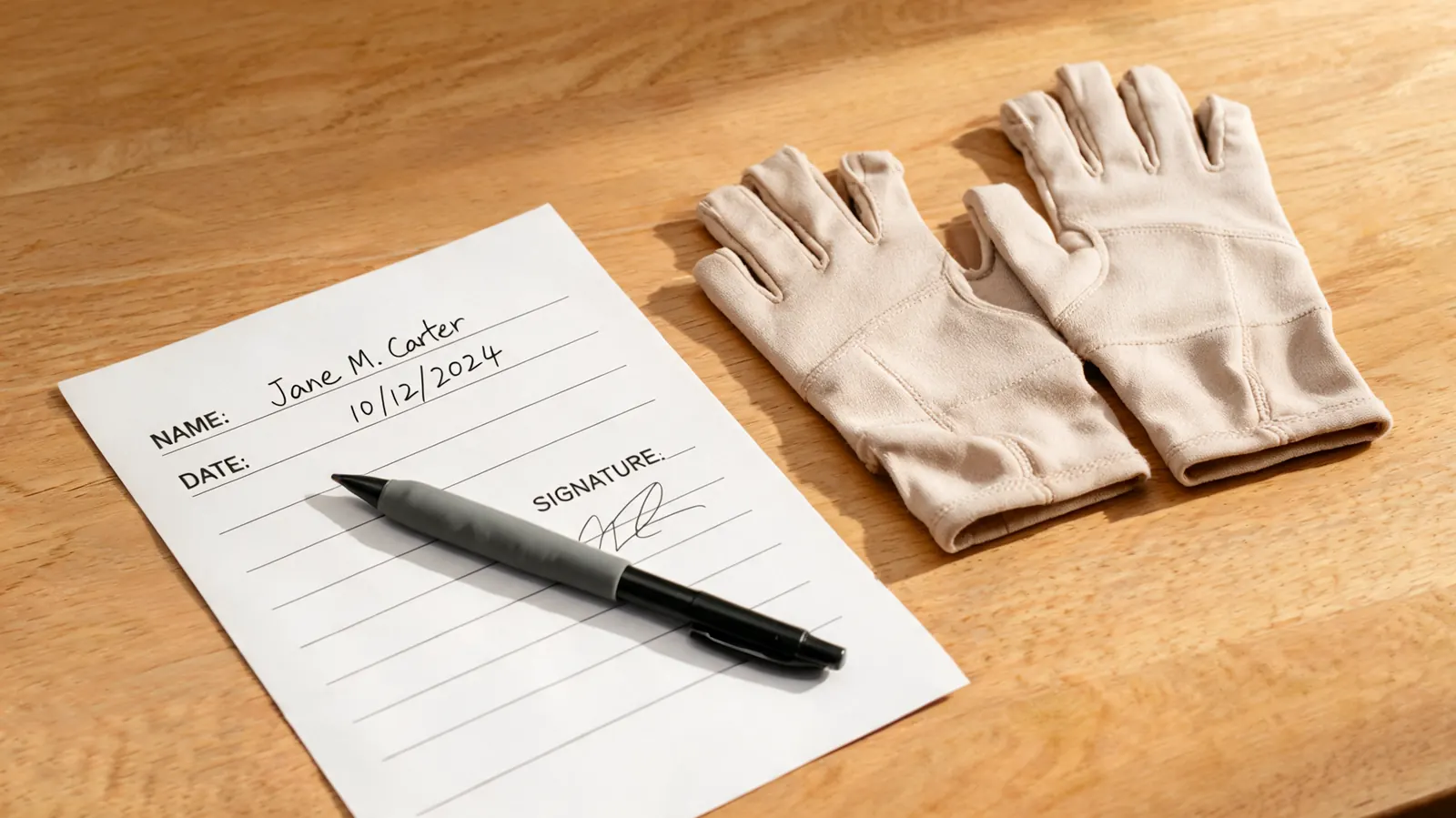
The first time I couldn't finish signing a lease, I was 28. My hands had been affected by RA for about a year, and I had learned to manage most of it. But sitting across from a landlord at a folding table, my MCP joints swelling against the pen, my fingers refusing to cooperate after the second page, I felt something I wasn't prepared for: embarrassment. Not pain. Embarrassment. Because writing is something you're supposed to just be able to do.
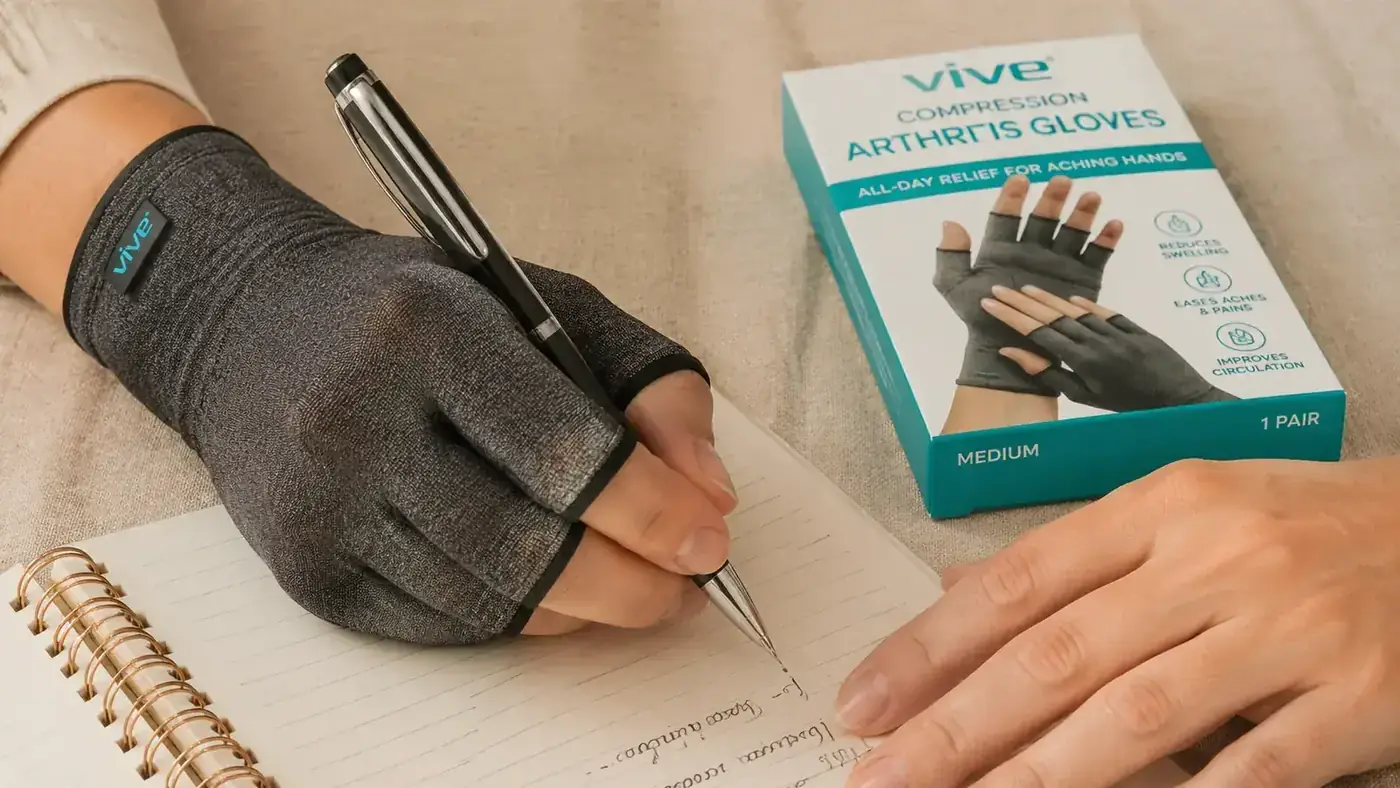
Writing and signing are among the first fine-motor tasks that RA disrupts. The reason is mechanical: holding a pen requires sustained grip force from the very joints most commonly attacked early in RA, the metacarpophalangeal joints at the base of your fingers and the proximal interphalangeal joints at the first knuckle. When those joints are inflamed, even a relaxed pen grip generates enough pressure to trigger pain within minutes. The answer is not to stop writing. It's to change the conditions before you pick up the pen. That starts with putting on compression gloves from Vive, and it continues with a set of small technique shifts that together make a meaningful difference.
Your hands hurt because the joints are inflamed. Compression lowers the baseline before you even touch a pen.
Vive Compression Arthritis Gloves are open-finger, rated 4.3 stars across 22,000+ reviews, and designed specifically for RA and osteoarthritis hand involvement. They cost less than a co-pay.
Amazon Check Today's Price on Amazon →Step 1: Put the Compression Gloves On Before You Reach for the Pen
This sounds obvious but almost nobody does it in the right order. Most people with RA hands sit down to write, notice it hurts after a few minutes, and then reach for the gloves as a response to pain. By that point your joints are already inflamed and active, and the gloves are playing catch-up. The correct sequence is to put the gloves on as part of your pre-writing setup, before the pen is in your hand.
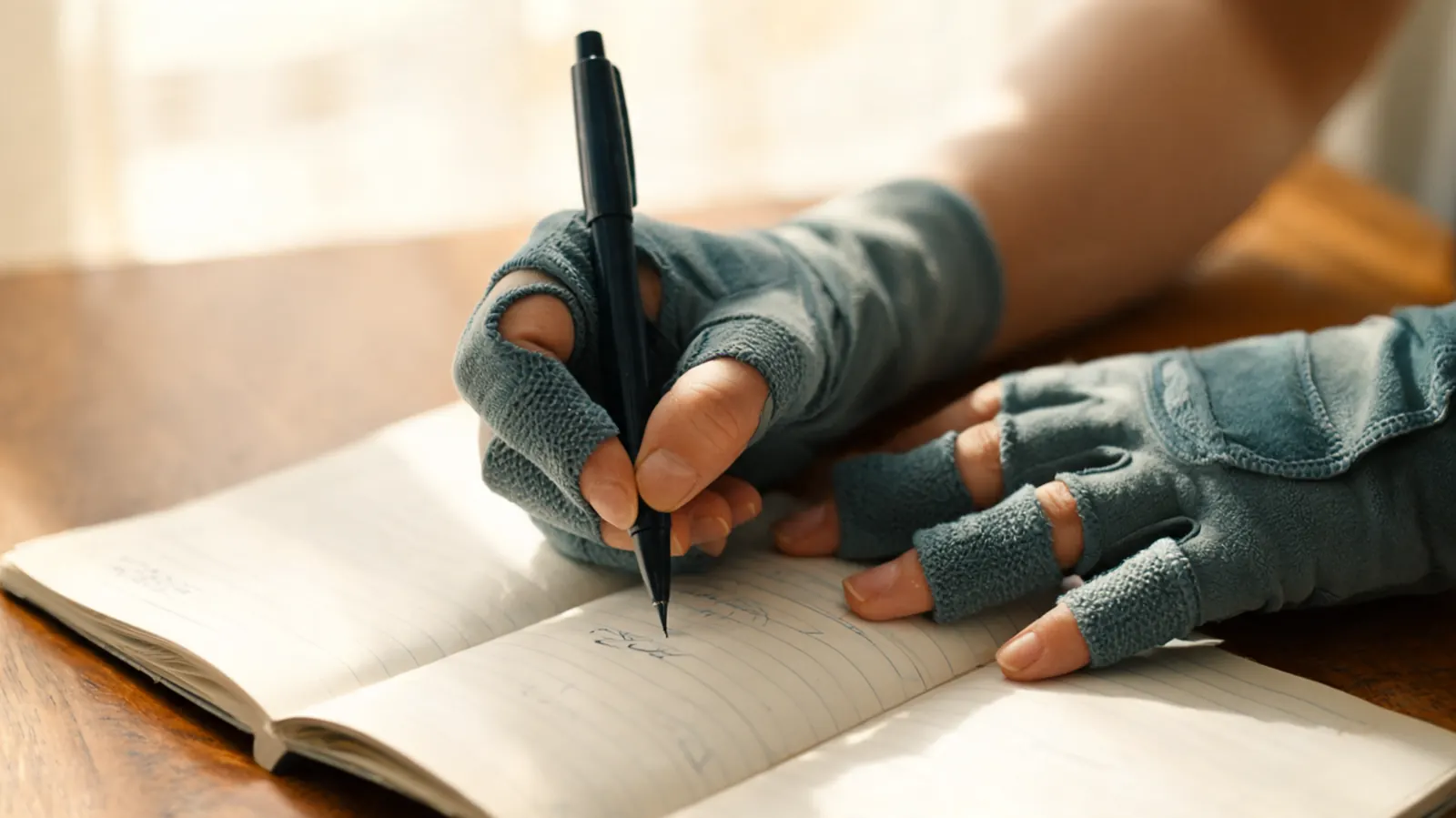
Compression works by applying gentle circumferential pressure that reduces the volume of fluid that can accumulate in the joint capsule and surrounding soft tissue. When you wear the Vive gloves for 15 to 20 minutes before a writing session, you're reducing that inflammatory baseline, which means your fingers can actually flex and grip with less resistance and less pain. The open-finger design matters here: your fingertips remain free so you can feel the pen, the paper, and the angle without guesswork. Wear them through the entire writing session, not just at the start.
Sizing matters more than people expect. If the gloves are too loose, you lose the graduated pressure. If they're too tight, you'll cut off circulation and your fingers will go numb within minutes. Vive provides a knuckle circumference sizing guide. Take the measurement seriously. When the fit is right, the gloves should feel snug but not constricting, and you should be able to flex all four fingers without the fabric pulling.
Step 2: Pick the Right Pen, Because Your Old Bic Will Work Against You
A standard ballpoint pen has a barrel diameter of roughly 8 to 9mm. That is thin enough that gripping it requires your finger flexors to work hard to maintain contact. For healthy hands, this is invisible effort. For RA hands, it's 20 minutes of work your joints didn't budget for. The solution is a pen with a wider barrel, ideally 12 to 14mm, and a soft rubber grip zone that reduces the friction coefficient so your fingers don't have to clamp as hard.
Three pens worth knowing: the Pilot G2 in the 1.0mm tip version has a wider grip section than the standard. The Stabilo EASYbirdy is designed specifically for reduced-effort writing and has a wide triangular barrel that naturally distributes contact across three finger surfaces. Any pen labeled 'ergonomic' at an office supply store is worth picking up because those designs exist specifically to reduce the grip force required. Try a few. The one that lets you write for 10 minutes without your joints screaming is the one you buy in bulk.
Step 3: Add a Rubber Pen Grip Sleeve If the Pen Alone Is Not Enough
Rubber pen grip cushions are foam or silicone cylinders that slide over any pen barrel and widen its diameter by 6 to 10mm while adding softness. They cost under five dollars on Amazon for a pack of several. If you find a pen you like but its barrel is still too narrow for comfortable extended writing, a grip cushion solves that immediately without replacing the pen.
The grip cushion also functions as a tactile feedback amplifier. When your fingers are wearing compression gloves, some of the fine tactile sense through your fingertips is mildly reduced. A wider, softer surface compensates by giving a larger contact area, which means you don't have to grip harder to feel secure. The pen stays put with less force. This is not a small adjustment: research on grip compensation in inflammatory arthritis has consistently shown that reducing required grip force is the single most effective behavioral change for extending pain-free writing duration.
Step 4: Adjust Your Pen Angle to 45 Degrees, Not Vertical
Most people with RA who struggle to write are holding the pen too upright, often at 70 to 80 degrees from the paper surface. A nearly vertical pen requires significant wrist flexion to keep the tip in contact with the page, and it forces the DIP and PIP joints of the writing fingers to bear almost all the stabilization load. When those joints are inflamed, that load is the problem.
Lowering the pen angle to approximately 45 degrees from the paper surface redistributes the contact work. The pen barrel now rests partly against the web space between your thumb and index finger, which is a lower-sensitivity area in most RA presentations. Your wrist angle flattens out, reducing the tendon tension that runs through the carpal tunnel and over the MCP joints. Your fingers can stay in a more neutral, less flexed position. This single change, holding the pen at 45 degrees, is the most impactful technique shift in this entire guide, and it costs nothing.
The pen angle is the thing nobody tells you. I spent two years white-knuckling a vertical pen when all I needed to do was tilt it. Forty-five degrees changed everything about how long I could write without stopping.
Step 5: Change How You Grip, Thumb Side Contact and Loose Fingers
Most people were never taught how to grip a pen. You learned by watching adults write, and you copied a grip that works fine for healthy hands. The standard adult grip applies pressure primarily through the thumb pad and the distal phalanx of the index finger, both of which press toward each other to pinch the pen barrel from two directions. For RA hands, that pinch-from-pad grip directly compresses the joints that are most inflamed.
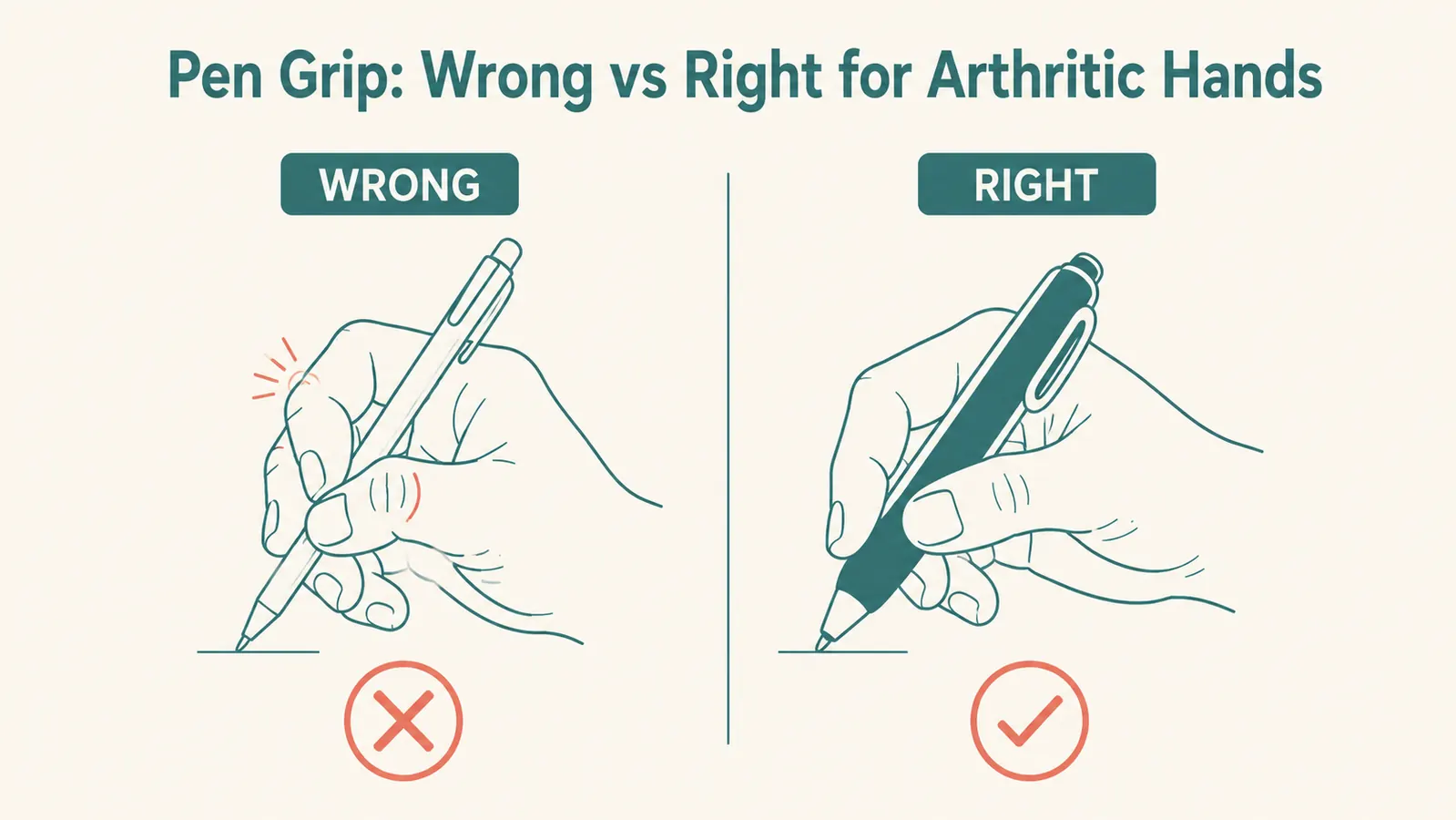
The modified grip for RA hands works like this: contact the pen with the side of your thumb, the lateral surface just below the thumbnail, rather than the pad of the thumb tip. Wrap your index and middle fingers around the barrel loosely, using the middle segment of the finger rather than the fingertip. Your ring finger rests against the barrel or paper as a stabilizer, not a gripper. Your pinky stays relaxed. You are not pinching the pen. You are cradling it with three points of contact, using bone structure for support rather than joint compression for force. The pen stays on the page through gravity and angle, not grip force.
See the diagram in the image above for a visual of the correct grip versus the common RA-aggravating grip. It takes about a week to retrain the muscle memory, and the first few days of writing with this grip will feel strange. By day five, most people find they can write significantly longer before pain sets in.
Step 6: Take a 30-Second Stretch Break Every 10 Minutes
Even with compression gloves, the right pen, and a corrected grip angle, sustained isometric tension in the hand flexors will accumulate over time. The practical solution is a timed break. Every 10 minutes of writing, set down the pen and do a brief hand opening. Extend all fingers as wide and flat as you comfortably can, hold for five seconds, then slowly close back to a relaxed neutral. Do this twice. Then make a soft fist, not forced, just loosely closed, and hold for three seconds. Open again. Total time: about 30 seconds.
This decompresses the joint capsules, flushes any accumulated fluid, and resets the resting tone in the intrinsic hand muscles. On days when your hands are close to a flare, increase break frequency to every five minutes. On low-inflammation days, you may find you can extend to 15 minutes between breaks. Listen to the hands, not the clock.
Step 7: Pre-Warm Your Hands Before Long Signing Sessions
When you know you're facing a long writing session, a closing on a house, a stack of forms at a doctor's appointment, a journal session you've been putting off, five minutes of heat application before you start makes a measurable difference. Warm water immersion is the simplest option: run a sink to the hottest comfortable temperature and soak both hands for three to five minutes, then dry them and put the compression gloves on immediately while the joints are still warm and loose. A paraffin wax bath, if you have one, does the same thing more effectively.
Heat works by increasing synovial fluid viscosity, which temporarily reduces the friction coefficient inside the joint capsule, and by reducing the resting tone in the periarticular muscles that are often splinted tight around an inflamed joint. The combination of pre-heat plus compression gloves plus corrected grip technique gives you the best possible writing conditions when the stakes are high and you can't afford to stop mid-page.
Step 8: End the Session With Stretches and Biofreeze Under the Gloves
When you finish writing, don't just pull off the gloves and move on. Take two minutes for a closing hand stretch routine: the same finger extension and fist sequence from Step 6, but slower and more deliberate. Follow that by applying a thin layer of menthol-based cooling cream, such as Biofreeze, across your knuckles and over the MCP joints. Then put the compression gloves back on over the cream and wear them for another 20 minutes.
This creates a sustained-release effect. The compression gloves hold the cooling cream against the skin surface and reduce surface evaporation, extending the active period of the menthol by 30 to 45 minutes compared to applying cream without the gloves. For post-session recovery, this sequence, stretch, apply cream, replace gloves, is one of the most consistently effective things I have found for keeping the next morning's stiffness from being as bad as it would otherwise be.
Step 9: Use Voice-to-Text as a Strategic Reserve, Not a Defeat
Your phone's voice transcription is better than most people realize. Both iOS and Android offer native keyboard dictation that handles punctuation commands and produces clean text at normal speaking pace. Google Docs has a voice input mode that works well for longer documents. This is not giving up. It is load management. Your hands have a daily capacity budget, and writing by hand draws from that budget faster than almost any other fine-motor task.
The practical protocol: use the gloves and proper technique for writing that requires physical presence, signatures, handwritten notes, journal entries, anything that needs to be on paper. Use voice-to-text for everything else: drafting emails, making lists, taking notes during calls. Save the handwriting capacity for when it counts. Most people with RA hand involvement are losing writing capacity not because the disease is worse than it needs to be, but because they are spending hand budget on tasks that voice-to-text could handle at zero joint cost.
Step 10: Know When to Ask for a Typed Alternative
Almost every legal and medical form that exists as a paper fill-in also exists as a fillable PDF or an electronic form. Before any appointment or signing event, call ahead and ask: is there a digital version I can complete before I arrive? Most medical practices will email you a patient intake portal link. Most title companies can walk through a closing electronically if requested in advance. Most HR departments have digital versions of every paper form they hand out.
This is not a special accommodation request. It is a standard modern option that most offices have available and most people never ask about. You don't need to explain your diagnosis to request a fillable PDF. You can simply say you prefer to fill things out digitally. The answer will almost always be yes. Reserve handwriting for the situations where digital is genuinely not an option, and use all ten steps in this guide to make those situations as pain-free as possible.
What Else Helps Between Sessions
The steps above cover the writing session itself. Between sessions, a few habits extend your functional window. Wearing the Vive gloves for the first 30 to 45 minutes of the morning, before your hands have warmed up from normal activity, consistently reduces peak morning stiffness. Many people with RA find that their hands are most functional between 10 a.m. and 2 p.m., which is when the morning stiffness has resolved and the afternoon fatigue hasn't started. If you can schedule your highest-demand writing tasks in that window, you'll get more done with less pain.
If you're interested in the longer-term story of what these gloves do across months of daily wear, the full review at our Vive compression gloves review for RA hands covers 9 months of daily use in detail. And if you want to understand the full range of ways compression helps hand function beyond writing, the piece on 10 reasons compression gloves help RA hands goes deep on the mechanism. The personal account that resonates most with a lot of readers is the story at how compression gloves helped me grip things again, which covers the moment when basic daily tasks stopped feeling impossible.
The steps above only work if the compression baseline is right. Vive gloves are the starting point.
Open-finger design, fits RA hands specifically, 22,721 reviews, 4.3 stars. The investment is small. The difference in how long you can write before pain stops you is not.
Amazon Check Today's Price on Amazon →