
It was a Tuesday afternoon, about 2 p.m., and I was supposed to be working. I'm a project coordinator, I work from home, and I had a report due at four. Instead I was sitting completely still in my desk chair with my eyes closed, waiting for the SI joint flare to pass. It wasn't passing. The pain had started as a dull pressure in my lower left back around noon and had graduated into something that radiated sharp and deep down my left leg. Not a cramp. Not a pulled muscle. PsA inflammation in my sacroiliac joint, the kind I'd come to recognize after three years of living with it. The small device that eventually got me through these afternoons is the AUVON Dual Channel TENS Unit, which I'll explain in a moment. First, the Tuesday afternoon that pushed me to try it.
The problem that afternoon was that I couldn't take ibuprofen. It was a methotrexate day, my bi-weekly dose the night before, and stacking an NSAID on top of MTX that close is something my rheumatologist and I have talked about carefully. I had already taken my morning dose of naproxen. I was at my ceiling for the day. I sat there and suffered through forty minutes of it, managing maybe a paragraph of the report, until the worst of it eased off. That was when I decided something had to change.
I was diagnosed with psoriatic arthritis at 26. I had skin psoriasis since I was 22 and had spent four years being told by three different GPs that my back pain was 'muscle tension' and 'stress.' A referral to a rheumatologist finally got me the right bloodwork, imaging of my SI joints, and a name for what had been happening to my body for years. The diagnosis was both devastating and a relief. At least I knew. Asymmetric joint involvement, enthesitis at my right heel (the Achilles attachment point, specifically), and a nasty tendency toward SI joint flares that could knock me flat on an otherwise ordinary Tuesday.
By 29 I was on a biologic that was managing the bigger picture reasonably well. Systemic inflammation was down. The skin on my elbows had largely cleared. But breakthrough pain still happened, especially in the SI joint during weather changes or stress, and especially on methotrexate days when my options for fast relief were limited. My physical therapist had mentioned TENS twice in passing. 'It's worth trying for the SI joint specifically,' she told me at a follow-up. 'Get a portable unit. Use it during the day, at your desk.' I had written it off as too complicated and not worth it. That Tuesday afternoon made me reconsider.
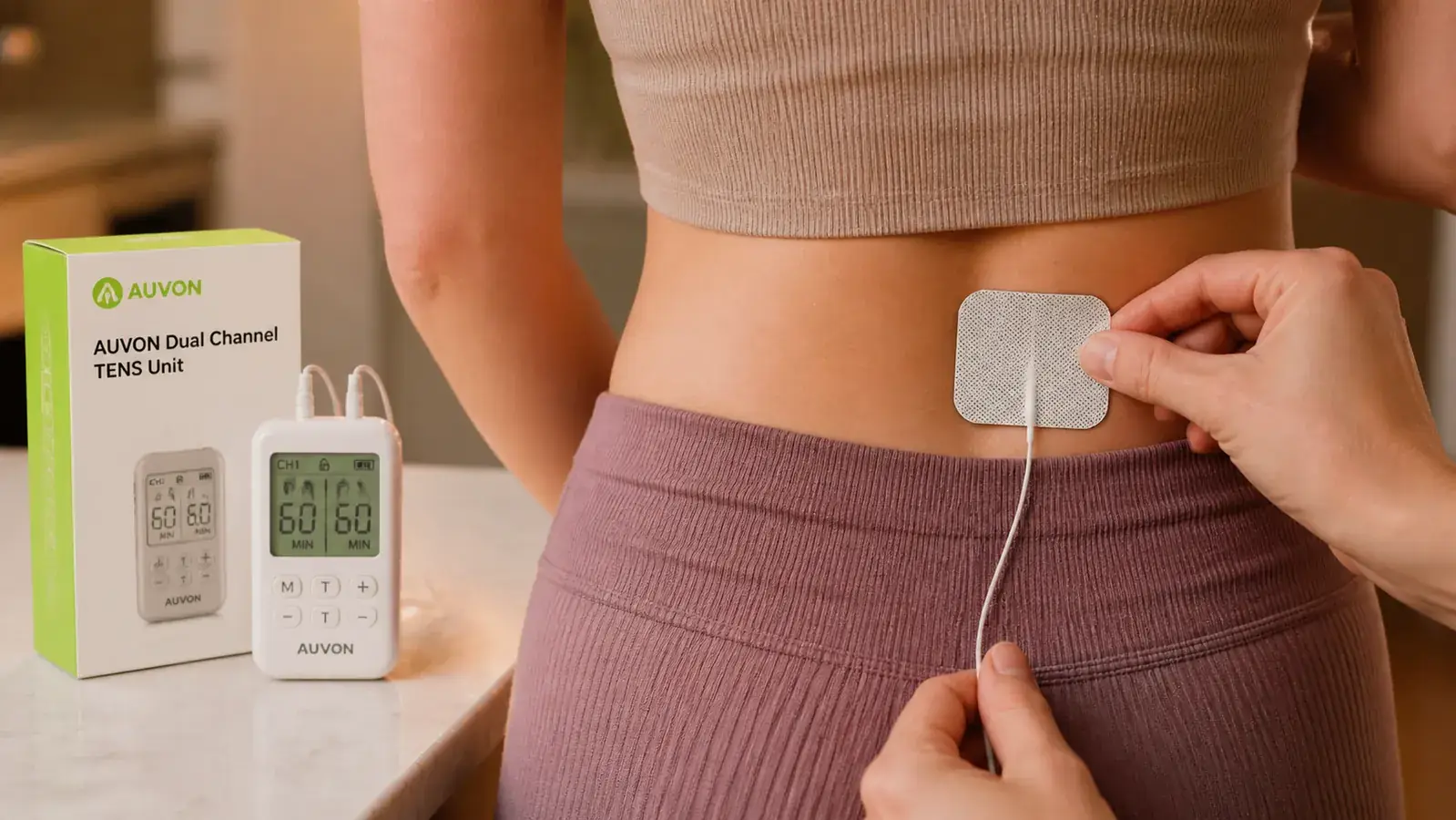
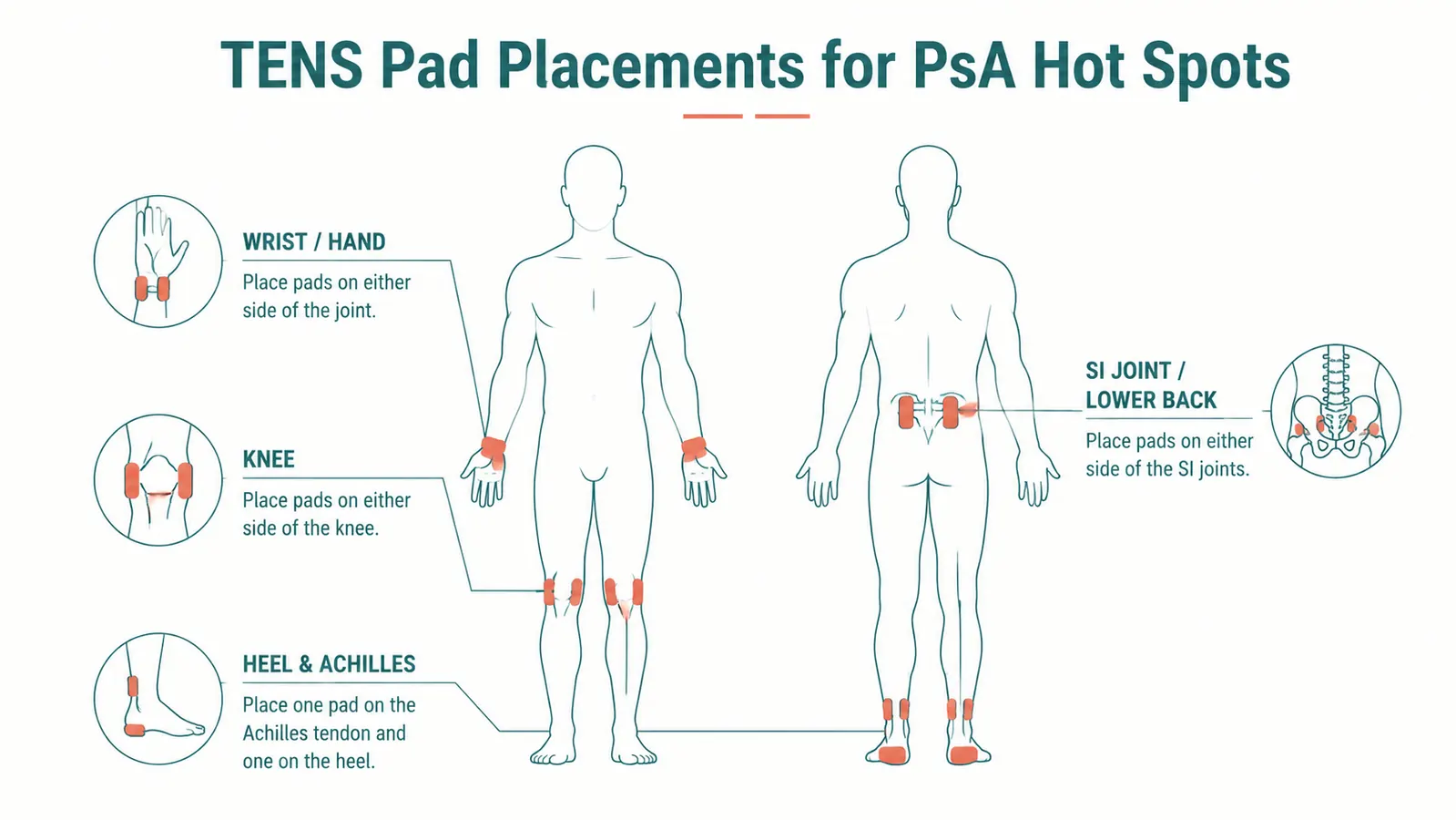
I ordered the AUVON Dual Channel TENS unit from Amazon that evening. It arrived Friday. Saturday morning I set up the pads on my lower back before a 6-mile walk I'd planned with two friends. I placed them just lateral to the spine on either side of the SI joint, following a YouTube guide, and turned it on to the massage mode at intensity four. Within about three minutes, the constant low-grade ache that I had accepted as my normal background state went genuinely quiet. Not gone, but quiet. Turned down from a 4 to something closer to a 1. We walked all 6 miles. I did not stop to sit down on a bench mid-walk, which is something I had been doing routinely on walks longer than 3 miles.
This isn't a treatment. It doesn't fix the psoriatic arthritis. It's more like a remote control for breakthrough pain. A way to turn the volume down enough to participate in my own life while the biologic handles the underlying fire.
Still pushing through SI pain with nothing but willpower and a daily NSAID ceiling?
The AUVON Dual Channel TENS unit is the same device I use for PsA breakthrough pain at my desk, on walks, and during long drives. Rechargeable, portable, 24 modes including the massage setting I use most. Budget-friendly on Amazon.
Amazon Check Today's Price on Amazon →The moments that matter most since then have not been dramatic. They've been ordinary Tuesday afternoons. Like working at my standing desk for four hours straight, which I have not been able to do without significant lower back protest since before my diagnosis. Or the drive to my parents' house five hours away, which I used to break into two segments with a mandatory stop at a rest area to lie flat in the back of my car for fifteen minutes. I did it straight through last month. Hips got tight around hour four and I turned on the TENS, clipped the unit to my waistband, and drove the last hour with the pads running under my shirt. Long restaurant dinners with my partner where I used to spend the last forty-five minutes shifting constantly in the booth because the SI joint was loading up. Last week I didn't shift once.
I want to be honest about what it doesn't do. It has done nothing for my hand involvement. When my fingers are swollen and stiff in the morning, the TENS unit is the wrong tool entirely. Electrode pad placement on small joints is impractical and the pain mechanism is different. And I want to be clear: this is not a substitute for methotrexate or my biologic. The day I skip my biologic because I feel fine is the day things quietly get worse again. The TENS unit is a symptom management tool, same category as heat, ice, and topicals. It just happens to work better than either of those for SI joint pain, for me, on breakthrough days. One more caveat specific to PsA: I have a psoriasis plaque on my left hip that I have to route the electrode wires around, because you do not put pads on psoriatic skin. That took one adjustment session to figure out, and now it's automatic.
For the enthesitis at my heel, it's been useful there too. I run the pads along either side of the Achilles attachment when the right heel gets hot and stabby, usually in the morning. It doesn't resolve the flare but it takes the edge off enough that I can walk normally to the kitchen without limping past my partner in a way that makes him wince for me. That matters. The small indignities of this disease are the ones that accumulate.
What I'd Tell You If We Were Sitting at My Kitchen Table
If you have psoriatic arthritis and you've been told to take your meds, wait for the biologic to kick in, and manage your expectations, I understand that completely. That is real advice and it's not wrong. The biologic is doing the foundational work. But there's a gap between 'the medication is managing your systemic inflammation' and 'you can actually get through a Wednesday afternoon without staring at the ceiling.' The TENS unit lives in that gap. It's a middle-game tool. It costs about what two co-pays cost. It doesn't require a prescription. It fits in a jacket pocket. I use the AUVON specifically because it has two channels so I can run two separate pad placements at once (SI joint and heel on a bad day), it holds a charge across a full week of use, and the 24 modes mean I've been able to dial in the setting that works best for nerve-adjacent SI inflammation versus enthesitis. If you want to read a deeper breakdown of the specific modes and pad placement techniques for inflammatory arthritis before you order, the full review is over at the AUVON TENS unit review for arthritis pain relief, and there's a practical guide for first-time users at how to use a TENS unit for arthritis joint pain. And if you want to see more use cases specific to PsA, RA, and other inflammatory conditions, 10 ways a TENS unit helps young people with arthritis covers more ground. It's budget-friendly. It changed how I get through Wednesday afternoon.
The device I use for PsA SI joint pain, Achilles enthesitis, and long drives.
AUVON Dual Channel TENS Unit. 24 modes, rechargeable, 12 pads included, two channels for running separate placements at once. The same model I've been using for over a year. Check the current price on Amazon before the next flare finds you without options.
Amazon Check Today's Price on Amazon →