If you have rheumatoid arthritis, psoriatic arthritis, lupus, or ankylosing spondylitis and you've walked into a pharmacy asking about joint supplements, you've almost certainly been pointed toward glucosamine. It's the default. It's what every pharmacist reaches for, what every well-meaning relative recommends, and what most "joint health" articles list first. The problem is that glucosamine was developed for a completely different disease than the one you have.
I'm Linda. I've had rheumatoid arthritis since I was 28. For the first year after my diagnosis, I took a glucosamine and chondroitin combo, the kind you find at every drugstore. My rheumatologist hadn't specifically recommended it, but I'd read enough forum posts and well-meaning blog articles to think I should try it. It didn't do much. Looking back, the reason is pretty simple: glucosamine targets cartilage rebuilding in osteoarthritis, the mechanical wear-and-tear kind. My joint destruction isn't mechanical. It's inflammatory. My immune system is the source of the problem, not years of physical load on a joint. I was using a tool designed for a different job.
| Turmeric Curcumin | Glucosamine + Chondroitin | |
|---|---|---|
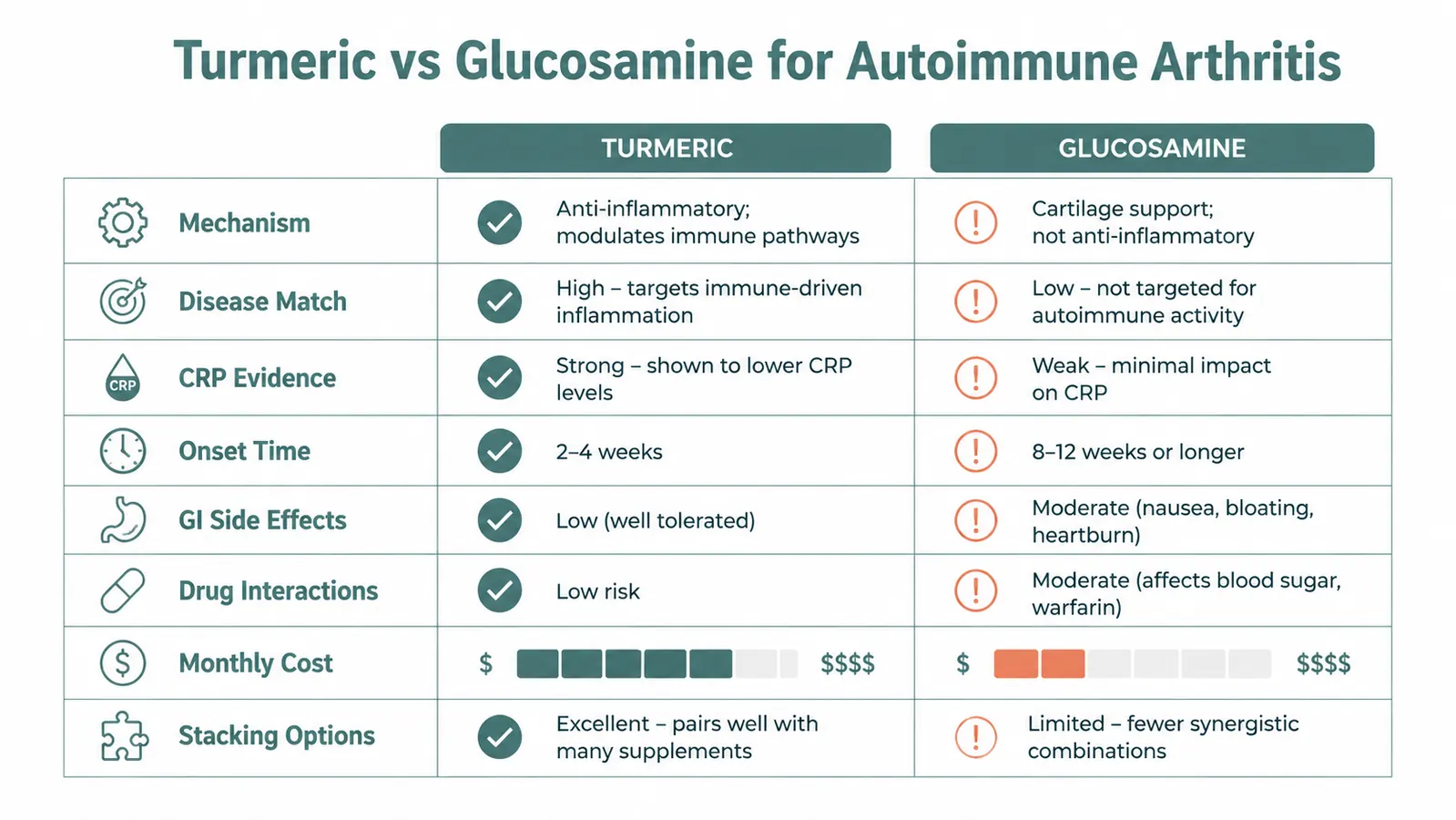
| Primary Mechanism | Suppresses NF-kB pathway, reducing gene-level inflammatory signaling throughout the body | Provides cartilage building blocks (glucosamine, chondroitin sulfate) for joint substrate repair |
| Disease Match | Designed for systemic inflammation: RA, PsA, lupus, ankylosing spondylitis | Designed for osteoarthritis, mechanical wear-and-tear cartilage degradation |
| CRP / Inflammation Evidence | Small-trial evidence for CRP reduction and reduced inflammatory marker levels in RA patients | Minimal to no meaningful evidence for CRP reduction in autoimmune arthritis populations |
| Onset Time | 8-12 weeks of consistent daily use to evaluate effect | 8-12 weeks of consistent daily use to evaluate effect |
| Side Effect Profile | Mild GI upset possible. Antiplatelet effect: use caution if on blood thinners or NSAIDs. Check with rheumatologist. | Shellfish allergy risk (most glucosamine is shellfish-derived). Can affect blood sugar in diabetics. |
| Monthly Cost | Moderate monthly cost at standard dosing (NatureWise 2250mg, 3 caps/day) | Moderate monthly cost for a mainstream glucosamine + chondroitin combo (e.g. Move Free, Cosequin) |
| Best Stacking Options | Pairs well with omega-3 fish oil and boswellia serrata for a fuller anti-inflammatory stack | Traditionally paired with MSM for a cartilage-focused approach |
| Who It Is For | Anyone with autoimmune or systemic inflammatory arthritis who wants anti-inflammatory supplement support | Anyone with diagnosed osteoarthritis or post-injury mechanical joint damage seeking cartilage support |
If your arthritis is inflammatory, the right supplement starts here.
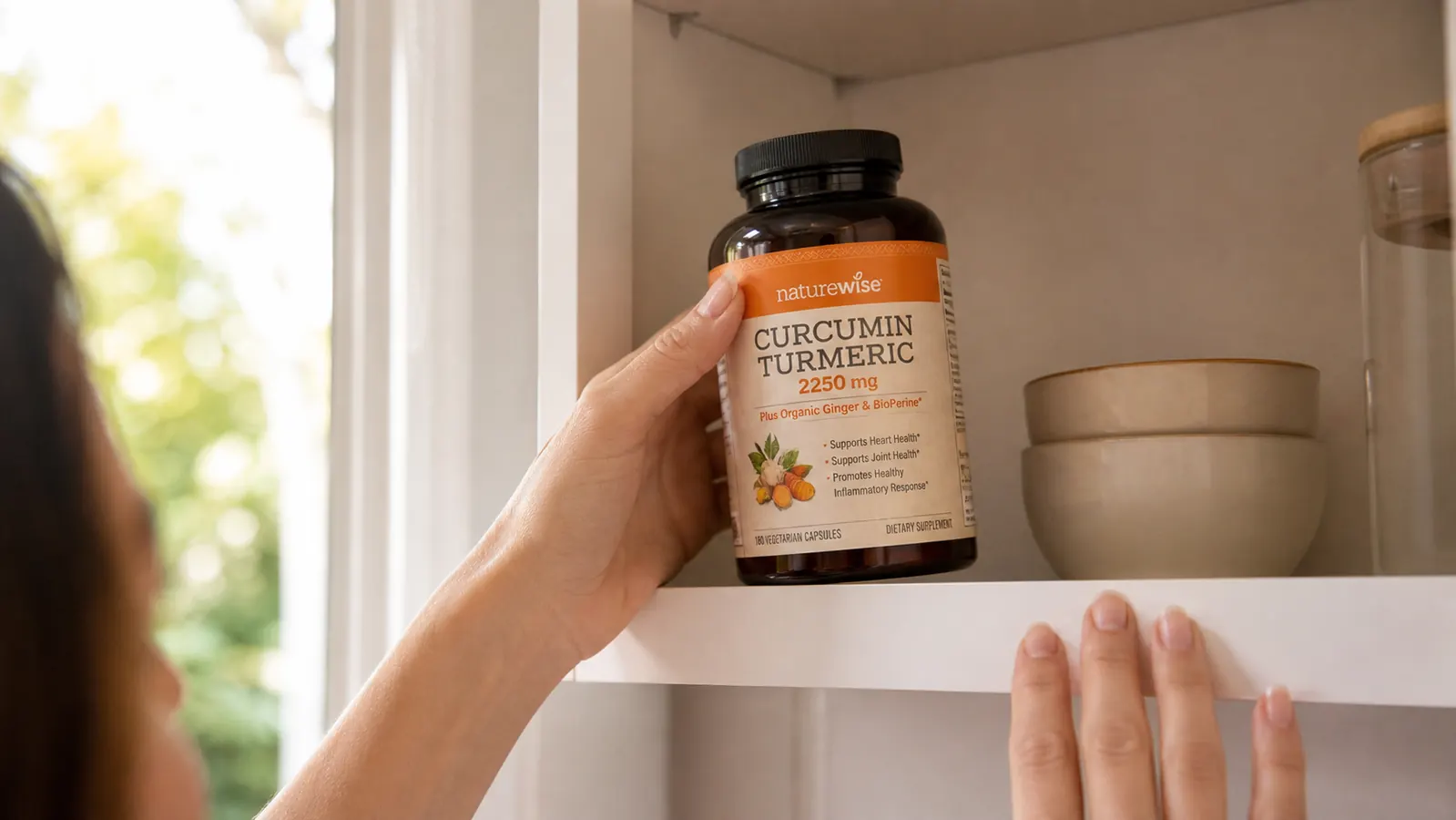
NatureWise Curcumin Turmeric 2250mg uses BioPerine black pepper extract for up to 20x better absorption. It's the formulation I've taken daily for over a year and the one most consistently recommended in RA and psoriatic arthritis patient communities.
Amazon Check Today's Price on Amazon → →The Core Difference: Mechanism Matters When Your Arthritis Is Autoimmune
Osteoarthritis and autoimmune arthritis are not the same disease. They happen to share the word "arthritis" and they both cause joint pain, but the underlying process is completely different. Osteoarthritis is mechanical: over decades, the cartilage that cushions your joints wears down. Glucosamine and chondroitin were developed to address that. The idea is that supplementing with cartilage building blocks might slow that degradation or help rebuild what's been lost. The evidence for this is mixed even in OA, but that's the rationale.
Autoimmune arthritis, which includes RA, psoriatic arthritis, lupus-related arthritis, ankylosing spondylitis, and several related conditions, works differently. Your immune system is attacking joint tissue directly. The destruction is driven by inflammatory cytokines, immune cell activity, and specifically by the NF-kB signaling pathway, which controls the gene-level expression of many inflammatory proteins. Giving your joints more cartilage substrate doesn't address that process. It's the wrong intervention for the wrong disease.
Curcumin, the active compound in turmeric, works at the NF-kB level. Multiple studies have shown curcumin can inhibit NF-kB activation, which reduces downstream production of TNF-alpha, interleukin-6, and other inflammatory markers. Those are exactly the pathways that matter in RA and related conditions. The trials are small and the effect size is modest, but the mechanism is actually relevant to what's happening in your joints. That's the key distinction.
Why GPs and Pharmacists Keep Recommending Glucosamine to Everyone
This is worth understanding, because it can feel dismissive or confusing when you've just been diagnosed with RA at 29 and a pharmacist confidently hands you a glucosamine bottle. The reason it happens is simple: the vast majority of arthritis is osteoarthritis. Osteoarthritis is the world's most common joint condition. When a pharmacist or GP thinks "joint supplement," glucosamine is the correct reflex for the majority of patients they see.
Inflammatory autoimmune arthritis affects somewhere between 1-3% of the population depending on the condition. It's statistically uncommon, and the people who get it are disproportionately young adults who don't fit the expected "arthritis patient" profile. The result is that a lot of young people with RA, PsA, or lupus spend months or years taking glucosamine, not because anyone looked at their situation carefully, but because it's the default recommendation and nobody paused to ask what kind of arthritis they actually have.
If your diagnosis is specifically autoimmune, it's worth pushing back a little. Ask: is this supplement designed for inflammatory arthritis, or for osteoarthritis? The answer to that question determines whether you're using the right tool.
Glucosamine addresses cartilage wear-and-tear. Autoimmune arthritis isn't wear-and-tear. The supplement you need is the one that reaches your immune system's inflammatory signaling, not your cartilage substrate.
Where Turmeric Curcumin Wins for Autoimmune Arthritis
The evidence for curcumin in autoimmune arthritis is genuinely promising, with the important caveat that most trials are small and short-term. A 2012 pilot study published in Phytotherapy Research compared curcumin supplementation to diclofenac sodium in RA patients and found that the curcumin group actually had higher ACR response rates than the NSAID group, with better tolerability. That study had 45 participants, so it's a starting point, not a conclusion. But it's notable that curcumin outperformed an NSAID on inflammatory markers in that particular population.
More broadly, curcumin has shown consistent ability in cell and animal studies to suppress NF-kB activation, reduce CRP and IL-6 levels, and inhibit COX-2 enzyme activity, which is the same enzyme targeted by NSAIDs. The human trial data is thinner than we'd like, but the mechanism is sound and the safety profile is favorable for most people. For someone who is already on DMARD therapy and looking for supportive anti-inflammatory supplementation, curcumin fits that role better than any other common supplement in this category.
Absorption is the other key variable. Curcumin on its own is poorly absorbed. The research that shows benefits typically uses either BioPerine (piperine from black pepper, which dramatically improves absorption), lipid-based formulations, or phytosome complexes. NatureWise Curcumin 2250mg includes BioPerine, which is why I chose it specifically. Plain turmeric powder or low-quality capsules without an absorption enhancer are unlikely to deliver enough active curcuminoids to do anything measurable. If you're comparing formulations, that's the first thing to check.
Where Glucosamine Still Has a Role
Glucosamine is not useless. It's just not the right supplement for pure autoimmune inflammatory arthritis. If you have RA and you also have secondary osteoarthritis from joint damage caused by years of inflammation, which is common in longer-duration RA, then a glucosamine and chondroitin product might address that secondary mechanical component. OA and RA can coexist in the same joint.
Similarly, if you had a sports injury in your 20s that left you with early post-traumatic OA in a knee or shoulder, and you later developed RA, taking both supplements might make sense: curcumin for the systemic inflammation from RA, and glucosamine for the mechanical cartilage issue from the old injury. That's a question worth raising with your rheumatologist, who can review your imaging to determine whether cartilage loss is part of your picture.
The other situation where glucosamine might show up in your supplement stack is EDS or hypermobility spectrum disorder with secondary OA. If your joints are hypermobile and you've been grinding cartilage through years of excessive joint range of motion, the wear-and-tear component is real. But even in that case, the inflammatory component of hypermobility-related pain may respond better to curcumin than to glucosamine. It depends on what your primary pain driver is.
Side Effects and Drug Interactions: What to Know Before You Start
Curcumin has a few interactions worth knowing. It has mild antiplatelet properties, meaning it can thin the blood slightly. If you're on methotrexate, sulfasalazine, or biologics, this probably isn't a significant concern at supplement doses, but if you're also taking aspirin, warfarin, or another anticoagulant, you should flag it with your rheumatologist. Curcumin can also cause mild GI upset in some people, particularly at higher doses, which is why taking it with food matters. Very high doses, far above what you'd get from a normal supplement, can theoretically affect liver enzymes, but this is not a concern at typical therapeutic doses of 2000-2500mg of curcuminoid extract daily.
Glucosamine has a different risk profile. Most commercial glucosamine is derived from shellfish, specifically shrimp or crab shells, so it's contraindicated if you have a shellfish allergy. There's also some evidence that glucosamine may affect insulin sensitivity and blood glucose levels, which matters if you have type 2 diabetes or are prediabetic. Some people also experience GI side effects. Overall it's considered safe for most adults, but those two flags are worth noting.
Neither supplement is a replacement for your prescribed DMARD or biologic therapy. I want to be clear about that, because I've seen people in RA forums suggest that supplements can substitute for methotrexate or Humira. They can't and they shouldn't. What curcumin can do is provide supportive anti-inflammatory benefit as part of a broader management approach that includes your prescribed medications, movement, and other lifestyle factors. Always tell your rheumatologist what you're taking.
Pros
- Anti-inflammatory mechanism (NF-kB suppression) is directly relevant to autoimmune arthritis
- Small-trial evidence for CRP reduction and reduced inflammatory markers in RA patients
- BioPerine-enhanced absorption means more active curcuminoids actually reach your bloodstream
- Pairs well with other anti-inflammatory supplements like omega-3 and boswellia
- Favorable safety profile for most people on standard DMARD therapy
- Lower cost than many pharmaceutical-grade alternatives for supportive supplementation
Cons
- Human trial data is limited: small studies, short durations, no large-scale RCTs in autoimmune populations
- Antiplatelet effect requires a check-in with your rheumatologist if you're on blood thinners
- Some people experience GI upset, especially at full dose without food
- Takes 8-12 weeks of consistent use to evaluate any effect, requires patience
- Absorption varies significantly between formulations: cheap options without BioPerine are likely ineffective
Who Should Buy Curcumin, and Who Might Still Benefit from Glucosamine
Buy curcumin if your arthritis is primarily inflammatory. RA, psoriatic arthritis, lupus arthritis, ankylosing spondylitis, and undifferentiated inflammatory arthritis all fall into this category. If your rheumatologist has diagnosed you with an autoimmune or inflammatory condition, curcumin with BioPerine is the supplement category with the best mechanistic rationale for your disease. The NatureWise 2250mg formulation is well-reviewed in patient communities specifically because the BioPerine inclusion makes the absorption difference. You can read more about long-term use experience in our full NatureWise Curcumin review for autoimmune arthritis.
Consider glucosamine if you have diagnosed osteoarthritis, either as your primary diagnosis or alongside an inflammatory condition. If your imaging shows cartilage loss, bone spurs, or other structural OA changes, glucosamine and chondroitin may address that mechanical component. The overlap patient is the one who has had RA for 10+ years and has secondary OA in previously inflamed joints. In that case, a combination approach (curcumin for the inflammation, glucosamine for the cartilage component) is worth discussing with your rheumatologist.
Young adults who were handed glucosamine at diagnosis and didn't feel any benefit, this is probably why. It's not that the supplement is bad. It's that it was designed for a different disease. If you want a deeper dive into why curcumin specifically addresses the mechanisms at play in young inflammatory arthritis patients, our article on 10 reasons turmeric curcumin helps young arthritis sufferers goes through the mechanistic case in more detail.
Ready to try the supplement that matches your inflammation, not your neighbor's knee replacement?
NatureWise Curcumin Turmeric 2250mg with BioPerine is one of the highest-rated curcumin formulations on Amazon, with over 58,000 reviews. It's the version I've taken daily and the one I recommend to other young adults with inflammatory arthritis who ask me where to start.
Amazon Check Today's Price on Amazon → →