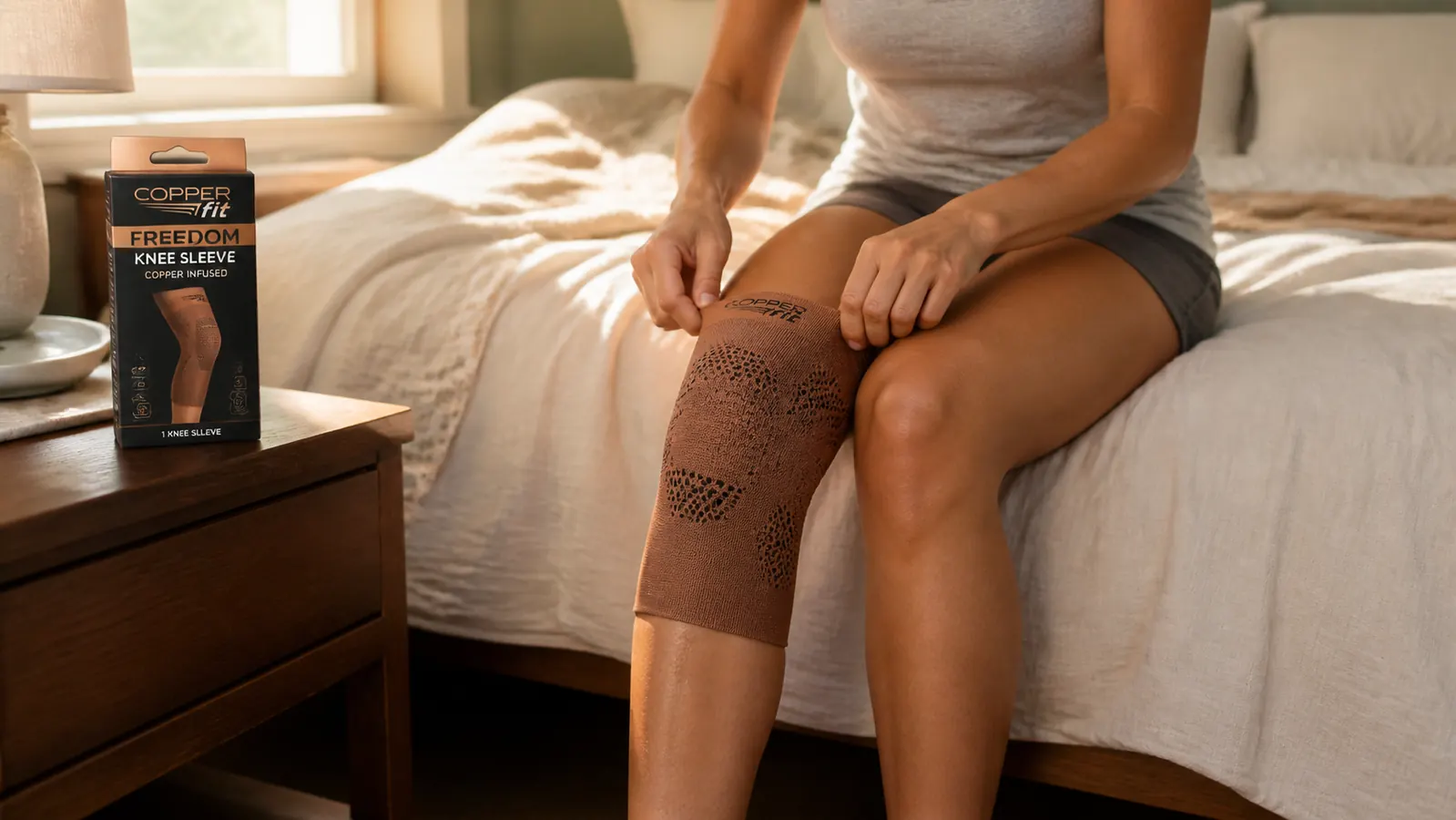

I spent the first three months after my diagnosis trying to hide the fact that I was in pain at work. I would smile through 9 a.m. stand-up meetings while my right knee throbbed, take the long way to the bathroom so I could walk slowly without anyone noticing, and then sit back down and spend the next hour dreading the next time I had to stand up. I was 31. I had an office job. And I was completely unprepared for what it would feel like to work a full 8-hour day with inflammatory knee arthritis. The single piece of gear that changed this for me, the one I'll keep referencing throughout this guide, is the Copper Fit Freedom Knee Sleeve.
The hard truth is that nobody gives you a workplace protocol when you are diagnosed with knee arthritis in your 30s. Your rheumatologist gives you a treatment plan, your physical therapist gives you exercises, but day-to-day work survival is mostly left for you to figure out on your own. This guide is what I wish someone had handed me in year one. It is not about pushing through the pain. It is about building a routine that lets you do your job without your knee deciding the agenda for you. The Copper Fit Freedom Knee Compression Sleeve is the foundation of that routine, and I will explain exactly when and how to use it across the whole workday.
Your knee starts its worst day the moment it sits down. Here is what helps.
The Copper Fit Freedom Knee Sleeve is the one thing I put on before I do anything else on a workday. It is low-profile enough to wear under pants, graduated compression to reduce morning swelling, and it does not roll down when you sit. Over 23,000 reviews, rated 4.2 stars.
Amazon Check Today's Price on Amazon →Step 1: Put the Sleeve On Within 10 Minutes of Getting Out of Bed
Morning stiffness is one of the most consistent features of inflammatory knee arthritis, and for many people with autoimmune conditions like RA or psoriatic arthritis, that stiffness window is real and has a timeline. For me, it peaks in the first 30 to 45 minutes after waking and then slowly loosens. If I put my compression sleeve on before I even make coffee, I am compressing the joint while it is at its most swollen and protecting it through the worst part of the morning.
The Copper Fit Freedom Knee Sleeve is thin enough that you can slide it on over pajama pants and then pull jeans or work trousers over it once you are dressed. Do not wait until you are about to leave for work. By then the inflammation has already had 40 minutes to do its thing unchecked. I think of putting the sleeve on as my first treatment of the day, not a last-minute addition to my outfit. If you want the full breakdown of how this sleeve performs under real daily wear, including how it holds up under jeans specifically, read the Copper Fit Knee Sleeve review from a young adult with arthritis.
Step 2: Choose a Desk and Monitor Setup That Does Not Make Your Knee Do Extra Work
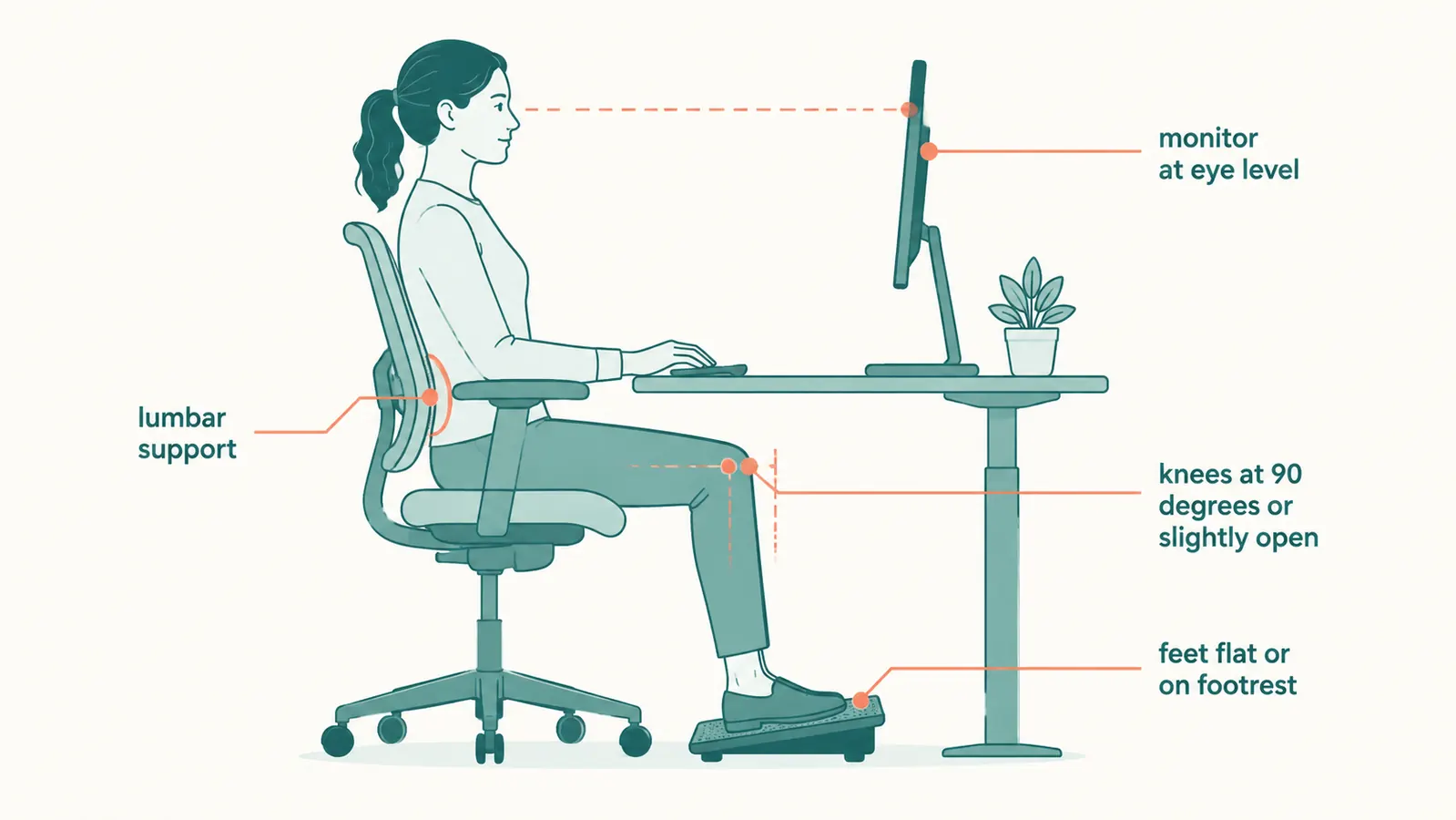
Poor desk ergonomics affect your knee more than most people realize. When your monitor is too low, you pitch forward and tuck your feet back under your chair, bending your knees beyond 90 degrees for hours at a stretch. When your chair is too high, your feet dangle and your knee hangs in an unloaded position that increases pressure on the kneecap. Both positions create subtle but cumulative strain on an already irritated joint.
The goal is knees at roughly 90 degrees with your feet flat on the floor or on a footrest, your monitor at eye level so your neck and upper back are not compensating, and your hips slightly above your knees if possible. A small adjustable footrest costs almost nothing and can take a surprising amount of pressure off a reactive knee. Think of it as passive treatment that runs all day in the background while you work.
Step 3: Set a Movement Timer for Every 50 Minutes
Chronic knee arthritis hates static immobility. Sitting completely still for 90 minutes allows synovial fluid to pool, local inflammation to increase, and the joint to stiffen so severely that standing up feels like a punishment. I learned this the hard way in back-to-back two-hour Zoom calls during my first year of remote work. By the time the second call ended I could barely straighten my knee.
A 50-minutes-on, 10-minutes-off rhythm works well for most desk workers with knee involvement. Set a phone timer or use a free app like Stand Up or Time Out. When the timer goes, stand up, walk to the kitchen, walk back. Even 90 seconds of gentle movement flushes the joint and resets the fluid dynamics. You do not have to do physical therapy exercises at your desk. Just break the static load regularly.
Sitting completely still for 90 minutes allows local inflammation to build and the joint to stiffen so severely that standing up feels like a punishment. A 50-minute timer changed that for me more than any supplement.
Step 4: Stack a Seated Heating Pad During Morning Stand-Up Calls
Heat is vasodilatory. It increases circulation to the joint, relaxes the surrounding musculature, and can meaningfully reduce the stiffness component of arthritis pain, especially in the morning when the joint is still warming up. A low-wattage lap-style heating pad placed over the knee during the first hour of your workday is a genuinely useful layer on top of the compression sleeve.
The practical trick is timing it during calls when you are already sitting still and screen-focused. Morning stand-up meetings where you are listening more than talking are perfect. Set the heating pad to its lowest or medium setting, put it on top of the sleeve, and let it run for 20 to 25 minutes. You are essentially running passive heat therapy while doing your actual job. One note: if your knee is acutely inflamed and feels hot to the touch, skip the heating pad that day. Heat on an already hot joint can increase swelling. On those days, consider whether a TENS unit might be more appropriate instead. For a more detailed comparison of those two approaches, see the TENS unit vs heating pad article.
Step 5: Do a 30-Second Knee Reset Before Walking Into Any Long Meeting
If you have been sitting for an extended period and you are about to walk into a conference room for a 90-minute meeting, do not just stand up and go. Give your knee 30 seconds to reset first. The sequence I use: stand up next to your desk, do 10 slow calf raises (rising up on your toes, lowering slowly), then do 5 slow shallow knee bends, just enough to get the fluid moving without loading the joint hard. That is it. Thirty seconds.
This matters more than it sounds. Walking into a long meeting with a stiff, just-unstuck knee means you will spend the whole meeting shifting in your chair trying to find a comfortable position. The brief reset gets the synovial fluid circulating before you sit back down into another extended position. It also makes the walk down the hallway noticeably less painful.
Step 6: Pack a Portable TENS Unit for Breakthrough Pain
There will be days when the compression sleeve and the movement breaks are not enough. Inflammatory arthritis does not follow your calendar. On those medium-bad days at the office, when the pain is a consistent 5 or 6 out of 10 and you have already taken your morning anti-inflammatory, a portable TENS unit in your desk drawer is a serious quality-of-life tool.
The AUVON Dual Channel TENS Unit is compact, rechargeable, and quiet enough to use under a desk during a non-video call without anyone knowing. You place the pads on either side of the knee, run a 20-minute session on a low pulse setting, and the gate-control effect can knock 2 or 3 points off the pain scale for an hour or more afterward. I keep mine in a small pouch with two sets of replacement pads. On a bad pain day, it can be the difference between finishing the workday at my desk and having to leave early. For a full guide on using one for arthritis specifically, see the AUVON TENS unit review.
Step 7: Build an End-of-Day Wind-Down Routine Before You Stand Up for the Last Time
How you end the workday matters as much as how you start it. After 7 or 8 hours of sitting, walking, and managing your knee, the joint is loaded and probably reactive. If you just stand up, grab your bag, and start your commute, you are asking an exhausted inflamed knee to immediately handle full body weight with no transition.
My end-of-day routine takes about 12 minutes. First, I take the compression sleeve off and apply a small amount of Biofreeze cooling cream to the front and sides of the knee, which interrupts the pain signal and feels genuinely relieving after hours of compression. I let the menthol absorb for a minute or two. Then I put my leg up on my desk chair at a slight elevation for 8 to 10 minutes while I close out emails. Elevation after a long sit reduces the fluid that pools in the joint over the course of a day. Then I stand up slowly, take a moment to assess, and head out. This wind-down is not optional on bad weeks. Skipping it means the evening at home is worse. For more on daily Biofreeze use as a topical tool, see the Biofreeze review for rheumatoid arthritis.
Step 8: Manage Flare Days With Intention, Not White-Knuckling
A flare day is not a regular bad day. If your knee is acutely inflamed, visibly swollen, and past a 7 on the pain scale, none of the steps above are going to get you through a normal workday and that is okay. Recognizing the difference between a hard day and a flare day is one of the most useful skills you can develop living with inflammatory arthritis.
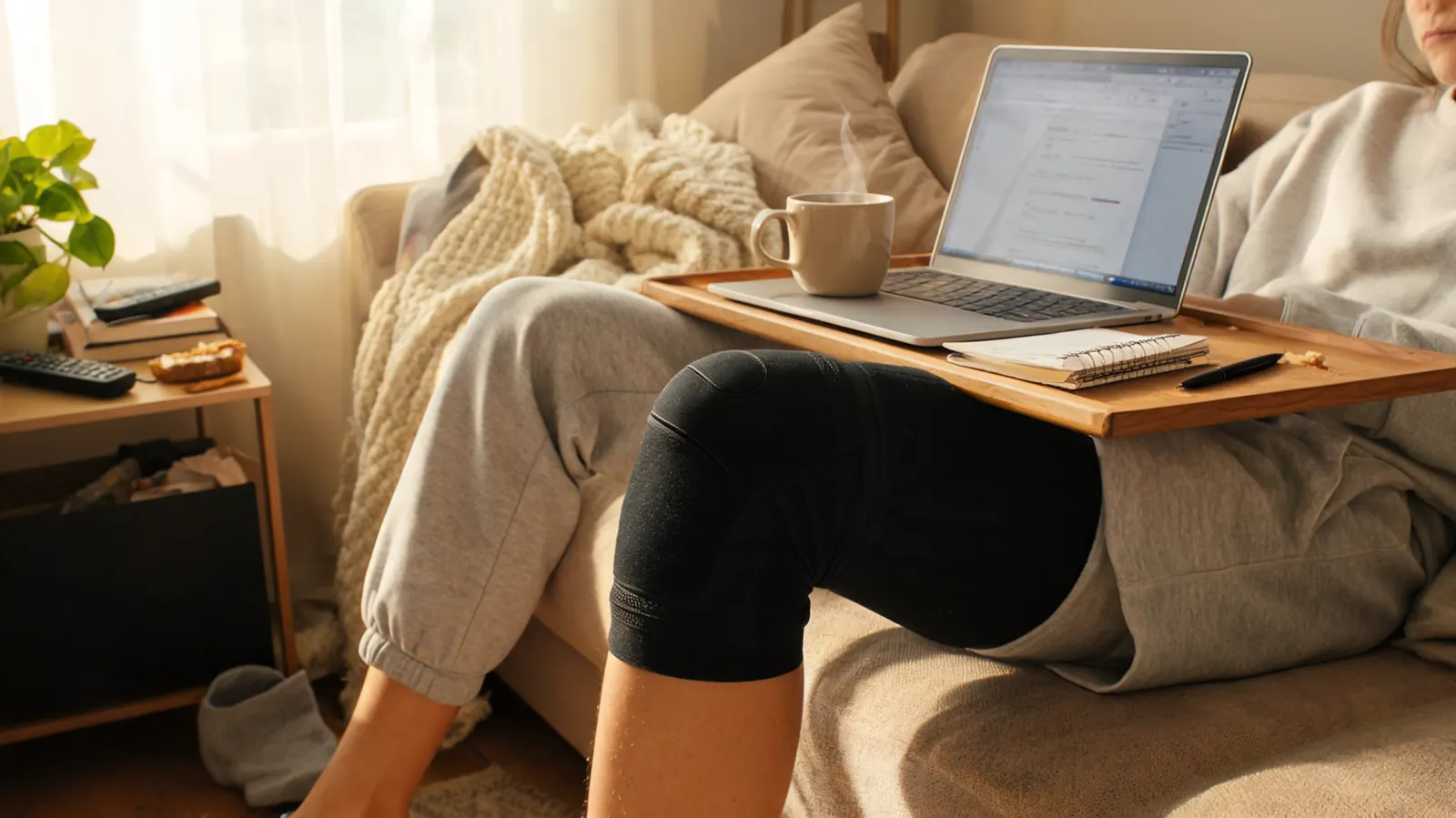
On a genuine flare day, the plan changes. If you have remote work capability, use it. Working from home means you can elevate your knee during calls, avoid the commute stress on the joint, and manage positioning without being in a fixed office chair. If you have a sit-stand desk or access to a prone-style standing option at home, use it in short intervals so you are varying the load. Eat the sick day or the PTO if you need to. Pushing through a moderate-to-severe flare causes real harm. It increases local damage, extends the duration of the flare, and sets back the following week. One day off now is better than five days of reduced capacity afterward.
The people around us often do not understand why arthritis pain can change that dramatically day to day. We look fine on Tuesday and can barely walk on Thursday. That is the nature of inflammatory joint disease, and a good flare-day protocol at work acknowledges it rather than fighting it. If you have colleagues or a manager you can be honest with, it is worth having a brief, plain conversation once so you are not constantly explaining individual days. You do not owe anyone your diagnosis. But having a clear accommodation in place before you need it makes flare days far less stressful.
For readers who are earlier in their daily-wear journey with the Copper Fit sleeve specifically, the story of wearing a knee sleeve under jeans every day for three months gives a first-person account of what that actually looks and feels like across a real workweek. And if you are still deciding whether a sleeve is the right tool at all, the roundup of 10 reasons a knee sleeve helps young arthritis sufferers covers the physiological case in plain language.
What Else Helps Beyond This Routine
This eight-step routine is a framework, not a prescription. A few things I have added over time that are worth mentioning: a small resistance band kept at my desk for seated clamshells and terminal knee extensions, which my PT taught me to do without standing up. A light pair of insoles in my work shoes, which reduced the secondary ankle and hip compensation I was developing. A knee pillow under the desk that lets me prop the leg in a slightly different angle on long call days. None of these are expensive or complicated. Incremental tools add up.
I also want to be clear about what this routine does not replace. It does not replace your rheumatologist's treatment plan. Compression and ergonomics are symptom management tools. They do not address the underlying inflammatory process driving your arthritis, whether that is autoimmune, post-injury, or early osteoarthritic. Think of this guide as the daily structure that keeps you functional while your medication and other treatments do their work.
The sleeve that started this whole routine for me.
The Copper Fit Freedom Knee Sleeve is what I put on every morning before I do anything else. Graduated compression, low-profile enough to disappear under jeans, and priced low enough that you can keep one at home and one at the office. 4.2 stars from over 23,000 reviews, including a lot of people who use it exactly the way this guide describes.
Amazon Check Today's Price on Amazon →