
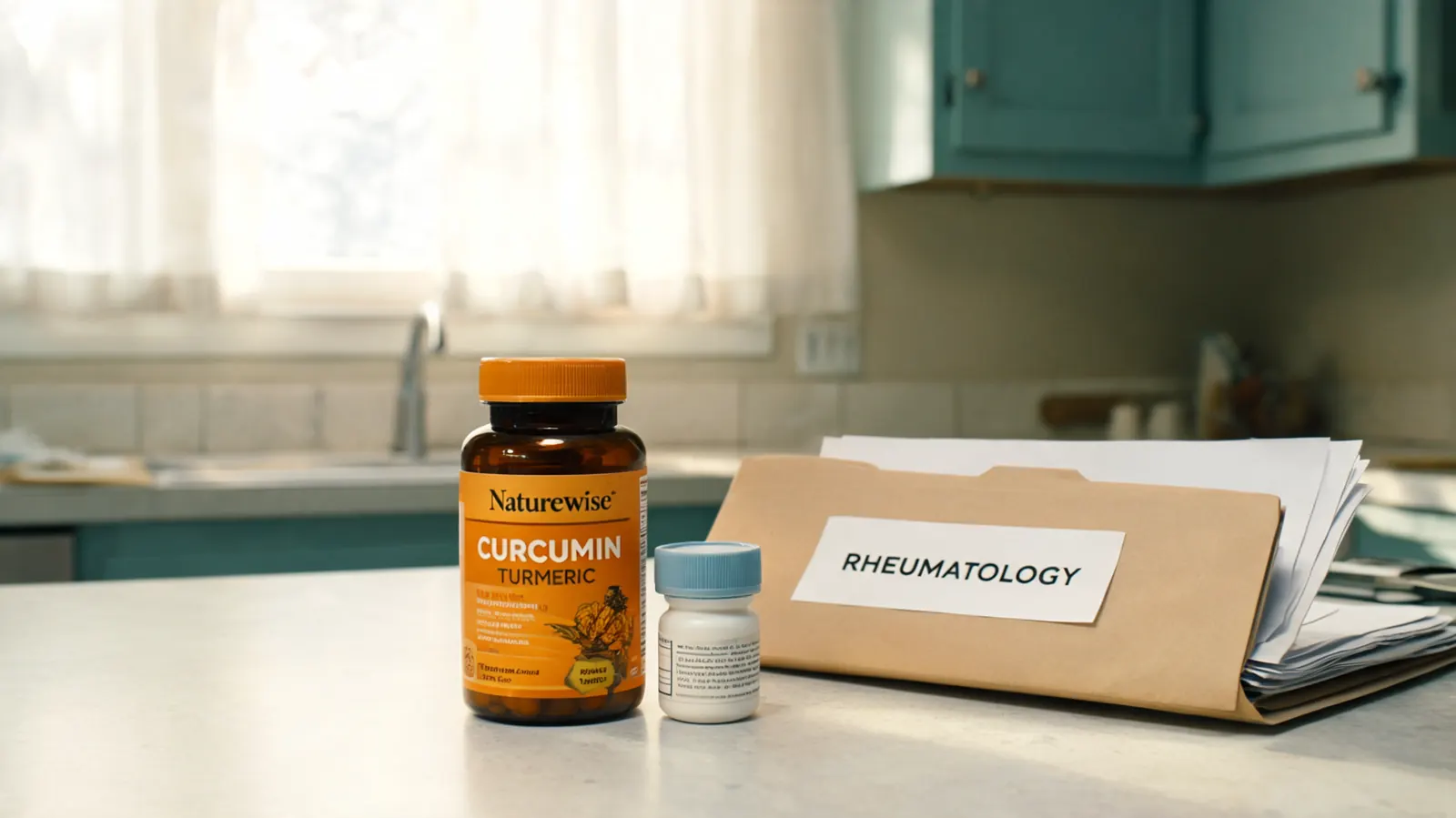
I have been taking NatureWise Curcumin Turmeric for a while now. I have RA diagnosed at 27 and I am always looking for anything that nudges my inflammation markers without adding another prescription to my already complicated stack. I want to tell you the things I had to find out the hard way, because the five-star reviews on Amazon are not going to tell you any of them.
NatureWise Curcumin Turmeric 2250mg is one of the most popular curcumin supplements on Amazon, sitting at 4.6 stars across more than 58,000 reviews. That sounds reassuring. But most of those reviewers do not have autoimmune arthritis. Most of them picked it up because their knee was sore after a weekend hike. You and I are not that person. So let me tell you what this supplement actually does, and does not do, when your joint pain is coming from an overactive immune system.
Quick Verdict
Worth trying as a supporting supplement for inflammatory arthritis, but it has real side effects most reviews skip, real drug interactions to check with your rheum, and research that is honestly weaker than the marketing implies. Go in with clear eyes.
Amazon Check Today's Price →Your CRP is not going to test itself. Start the supplement, start the tracking.
If you decide this is worth a try, NatureWise is a reasonable brand with NSF certification and a real BioPerine formula. Check the current price on Amazon before you buy anywhere else.
Amazon Check Today's Price on Amazon → →The Yellow Stain Problem Is Real and Nobody Warns You
Let's start with the thing you will discover on day three. Curcumin is essentially a highly concentrated form of turmeric, and turmeric stains everything it touches a vivid, permanent-looking yellow-orange. The NatureWise capsules are filled with a powder that does not stay powder-like once the capsule gets slightly warm or damp. I have stained a bathroom countertop. I have stained my fingertips. I once cracked a capsule while opening the bottle and got yellow on a white dish towel that did not come fully clean.
If you wear contact lenses, handle the capsules before your contacts come out and you will spend ten minutes wondering why everything looks vaguely orange. If you set the bottle on a light-colored surface with the lid slightly ajar, the fine powder that collects under the lid will transfer onto your countertop. This is not a flaw specific to NatureWise. It is turmeric. But it is genuinely not mentioned in the product description and it should be.
Practical workaround: take the capsule out over the sink or on a dark surface. Store the bottle away from anything you care about staining. Keep a dedicated spot for it in your cabinet. Once you have the system down it stops being annoying, but the first week will catch you off guard.
The GI Side Effects Most Reviews Bury in Paragraph Seven
High-dose curcumin, especially with BioPerine (the black pepper extract added to improve absorption), can cause gastrointestinal upset. We are talking about loose stools, mild diarrhea in the first week or two, and for some people a cramping sensation that feels like it might be coming from the gallbladder area. This is not rare. In clinical trials on curcumin supplements, GI upset is consistently the most common side effect reported.
The BioPerine specifically is the reason some people get reflux or heartburn they did not have before starting the supplement. BioPerine works by inhibiting certain intestinal enzymes and slowing gut motility slightly, which is how it improves curcumin absorption. But that same mechanism can irritate the lower esophageal sphincter in people who are prone to reflux. The workaround is simple: take the capsule with a full meal, not a small snack, and never on an empty stomach. If heartburn persists, try taking it at dinner instead of breakfast.
People with a history of gallstones should talk to a doctor before starting curcumin at this dose. Curcumin stimulates bile secretion, which sounds useful but can be uncomfortable or worse if you have existing gallbladder issues. Most supplement sites do not tell you this.
Drug Interactions Your Rheumatologist Needs to Know About
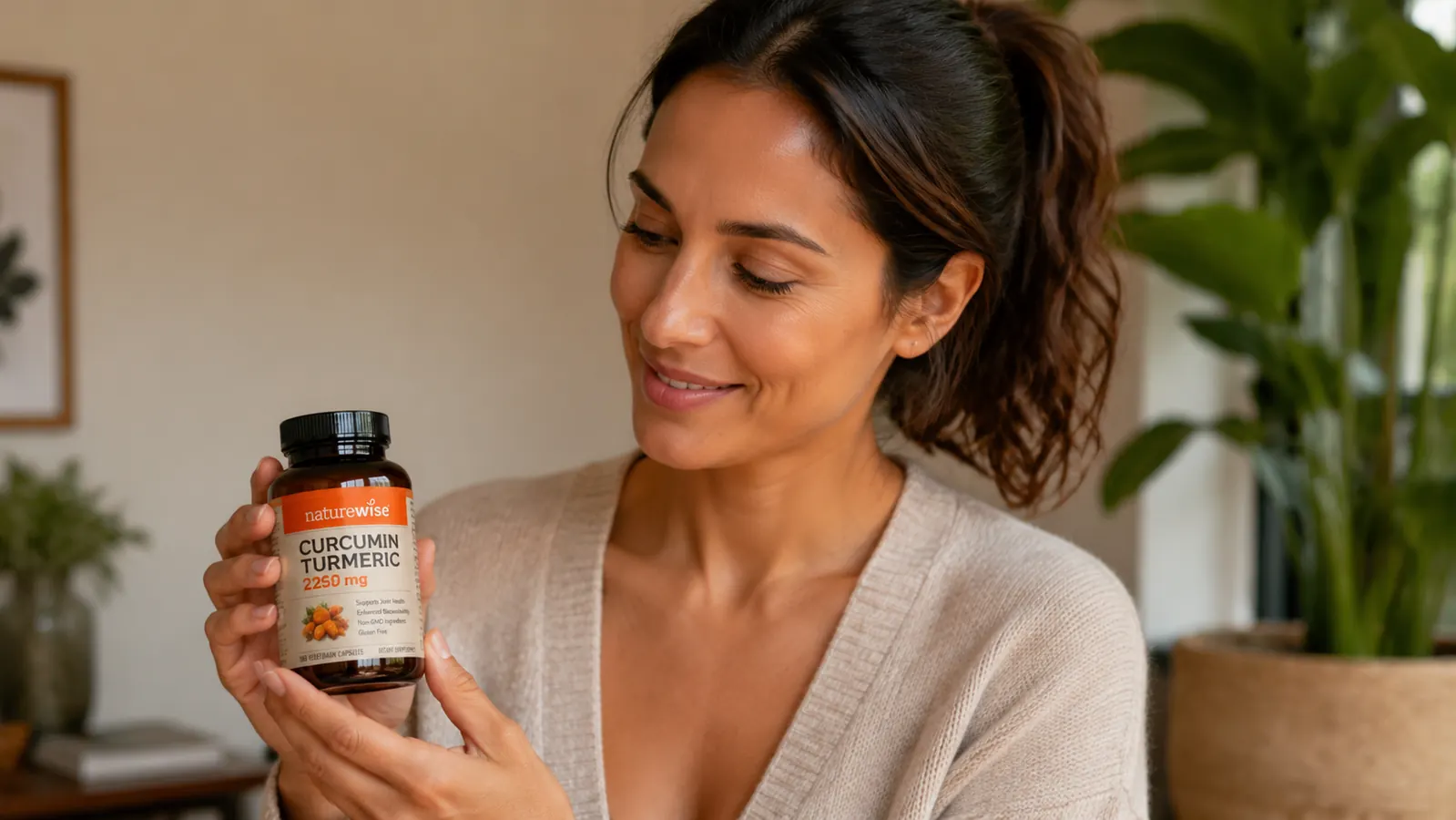
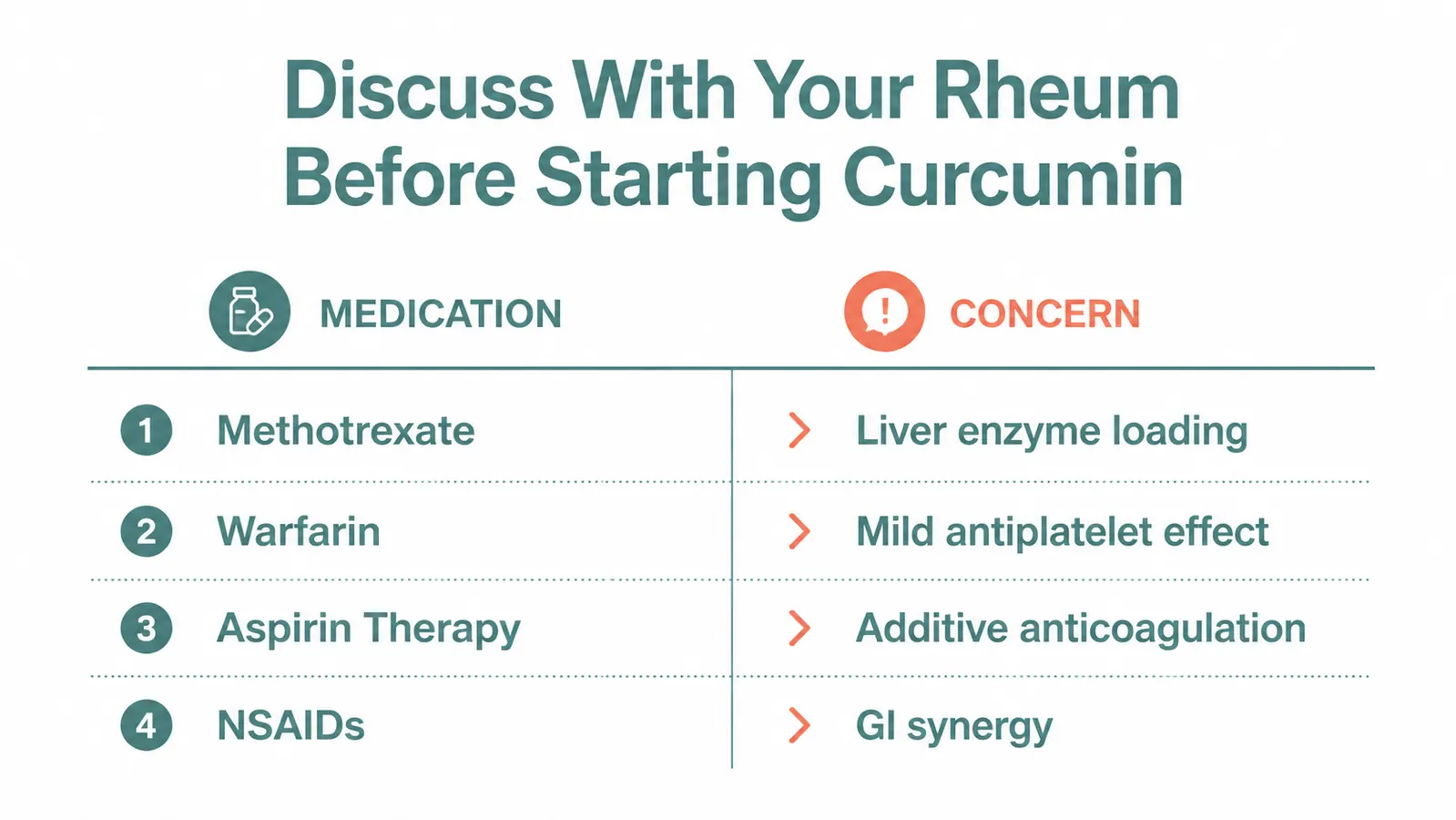
This is the part I most want you to read carefully. Curcumin has a mild antiplatelet effect, meaning it slightly inhibits blood clotting. For most healthy people this is not an issue. But if you are on warfarin, aspirin therapy, or any anticoagulant as part of your autoimmune treatment plan, adding high-dose curcumin without telling your provider is not a good idea. The additive effect is real, even if it is modest.
The other interaction that matters specifically for RA patients on disease-modifying therapy: methotrexate. Curcumin is metabolized partly through the liver, and so is methotrexate. Some animal studies have suggested curcumin may actually be hepatoprotective alongside methotrexate, which sounds like a positive. But some case reports and pharmacokinetic concerns suggest it could alter methotrexate serum levels. The evidence is not settled. The responsible thing to do is tell your rheumatologist you are adding curcumin before you start, not after three months of wondering why your LFTs look slightly off at your next blood draw.
None of this means curcumin is incompatible with RA treatment. It means you should have the conversation. Your rheum has heard weirder supplement questions. They will not judge you for asking.
Curcumin is not a replacement for your DMARD or your biologic. If your rheumatologist says you need methotrexate, you need methotrexate. This is a supporting player, not the lead.
What the Research Actually Says (Spoiler: It Is Weaker Than the Marketing)
The clinical research on curcumin and rheumatoid arthritis is genuinely interesting but honestly limited. Most of the human trials showing benefit for RA use doses between 500mg and 1000mg of curcuminoids per day, and some of the more encouraging trials used doses closer to 4000-8000mg of whole turmeric extract. NatureWise delivers 2250mg of total extract with 95% curcuminoids standardized, so approximately 2137mg of curcuminoids at the label dose. That puts you somewhere in the middle of the dose ranges studied.
The study most often cited in curcumin marketing is a small 2012 trial by Chandran and Goel that found curcumin outperformed diclofenac on ACR20 response in RA patients. It had 45 participants and ran for eight weeks. It is a promising signal, not a definitive result. Most subsequent trials have been similarly small and short. A 2016 systematic review in the Journal of Medicinal Food found consistent signals for curcumin reducing inflammation markers, but noted that most included studies had high risk of bias and short durations.
What this means practically: the evidence is encouraging enough to make the supplement worth trying as an adjunct to your medical treatment. It is not strong enough to replace a conversation with your rheumatologist about your actual treatment plan. The supplement companies will not say that plainly. I am saying it plainly.
Why Some of Us Feel Almost Nothing (It May Not Be Your Imagination)
I spent about six weeks taking NatureWise religiously and noticing... not much. I went back and read more about curcumin pharmacokinetics and found something that made my experience make sense. Curcumin absorption is influenced by genetic variation in cytochrome P450 enzymes, specifically CYP3A4, which is involved in curcumin metabolism. People who are fast metabolizers of CYP3A4 substrates clear curcumin more quickly, which reduces the bioavailable window.
Additionally, hormonal fluctuations appear to interact with curcumin's anti-inflammatory activity. Some researchers have observed that estrogen modulates NF-kB signaling, the same pathway curcumin targets. This may explain anecdotal reports from young women, including myself, of curcumin seeming to work better at certain points in the hormonal cycle and being almost imperceptible at others. No large clinical trials have nailed this down specifically for curcumin. But it is a plausible mechanism that gets zero column inches in the supplement marketing.
If you feel almost nothing after six weeks, consider: are you taking it consistently with a meal containing fat? BioPerine does help, but fat-soluble compounds including curcumin absorb significantly better with dietary fat present. Try taking it with your largest meal of the day. Give it a full twelve weeks before concluding it does nothing for you.
How to Actually Know If It Is Working
Subjective pain perception is a notoriously unreliable measurement, especially for people with autoimmune arthritis where symptoms fluctuate with disease activity, stress, sleep, weather, and what we ate two days ago. If you are serious about evaluating whether curcumin is doing anything, you need an objective anchor.
Ask your rheumatologist to pull a baseline CRP (C-reactive protein) and ESR before you start, then repeat at the three-month mark. CRP in particular is a relatively sensitive marker of systemic inflammation and can shift meaningfully in response to anti-inflammatory interventions. Keep a brief morning stiffness journal: how many minutes before your hands or whatever joints are affected reach reasonable function? Under ten minutes is a different picture than over forty-five. Some people find morning photos of swollen knuckles or ankles useful for comparison over time, because we tend to forget what baseline looked like.
If CRP does not budge in three months and your stiffness journal shows no improvement in morning function, that is informative data. This supplement is not working for you at this dose. That is a legitimate conclusion and it is okay to stop.
Storage, Expiry, and the NSF Certification Question
NatureWise's NSF certification is real and it matters. NSF International independently tests supplements for accurate label claims, contaminants, and manufacturing quality. That is meaningful in a supplement industry where a distressing percentage of labels are simply inaccurate. NatureWise passes that bar.
But the bottle does have a best-by date, and curcumin does degrade in heat and light. Storing this on a sunlit windowsill, above the stove, or in a cabinet next to the dishwasher (where steam and heat cycle regularly) will accelerate that degradation. Keep it in a cool, dark cabinet. If you live somewhere warm, the medicine cabinet in a centrally air-conditioned part of the house is better than the kitchen. Check the best-by date when you receive your bottle, especially if you order in bulk or from a third-party seller. Curcuminoid potency drops meaningfully as the product approaches or passes that date.
Pros
- NSF-certified third-party testing: what the label says is actually in the capsule
- BioPerine formula meaningfully improves curcumin absorption versus plain turmeric powder
- 2250mg dose puts you in the range of doses studied for inflammatory arthritis
- Well-tolerated by most people once GI adjustment period passes (usually 1-2 weeks)
- Reasonable cost at current price per serving compared to similar NSF-certified options
- Growing body of research showing signals for CRP and joint pain reduction as an adjunct to standard care
Cons
- Yellow staining is real: capsules stain countertops, fingertips, and fabric on contact
- GI upset (loose stools, cramping, heartburn from BioPerine) is common in weeks one and two
- Drug interactions with methotrexate, warfarin, and antiplatelet agents require a rheum conversation first
- Clinical research base is mostly small, short trials with real bias risk: evidence is promising not proven
- CYP3A4 genetic variation and hormonal cycle interactions mean some people may simply not respond
- Does nothing to address the autoimmune mechanism of RA: not a DMARD substitute under any circumstances
Who This Is For
NatureWise Curcumin makes sense if you have an inflammatory arthritis diagnosis (RA, psoriatic arthritis, lupus, ankylosing spondylitis) and you are already stable on your prescribed medical treatment. You want to add an evidence-adjacent anti-inflammatory supplement to support what your DMARD or biologic is already doing. You have talked to your rheumatologist and they have given you the green light, especially if you are on methotrexate or any anticoagulant. You are willing to track your baseline CRP and give it a full three months before deciding. You understand this is a supporting player in your inflammation management, not the main event.
Who Should Skip It
Skip NatureWise Curcumin, at least for now, if your rheumatologist has told you your disease is not controlled and you need to adjust your primary medication. Curcumin is not a substitute for that conversation. Also skip it if you have a history of gallstones or active gallbladder disease, active GI conditions like IBD that make loose stools a real problem, or if you are on significant anticoagulation therapy without having specifically discussed curcumin with your provider. If you are in the early months of a new diagnosis and are still finding your footing with your actual treatment, get that stable first. Then revisit this.
If you want a deeper look at how NatureWise performs over eight months of consistent daily use, including what changed at the two-month and six-month marks, read the long-term review at the link below. And if you want a step-by-step guide to using curcumin strategically as part of an inflammation management protocol, the how-to guide breaks down dosing, timing, and what to combine it with.
Internal reading: NatureWise Curcumin Review: What 8 Months of Daily Use Actually Did for My RA and How to Use Turmeric Curcumin to Actually Reduce Inflammation When You Live With Autoimmune Arthritis.
If your rheum has cleared you and you have a CRP baseline ready, this is a reasonable next step.
NatureWise Curcumin is not going to fix your autoimmune disease. But as an adjunct to real treatment, the evidence suggests it is worth a three-month trial for most people with inflammatory arthritis. Check today's price on Amazon and verify the best-by date when your bottle arrives.
Amazon Check Today's Price on Amazon → →