
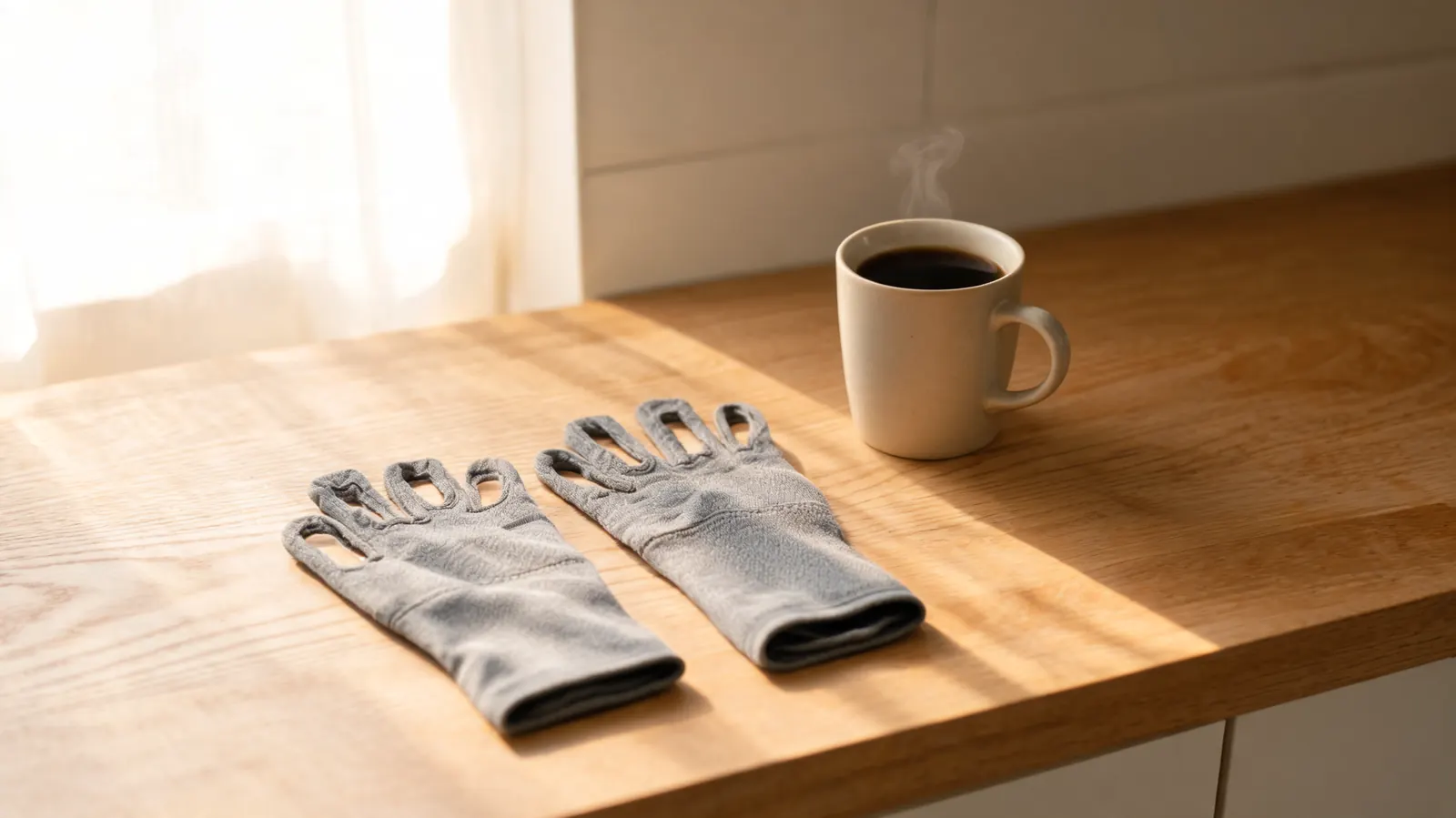
Let me tell you what the product listing for the Vive Compression Arthritis Gloves does not say. It doesn't say that your fingertips will still get cold and stiff because open-finger gloves expose them entirely. It doesn't say the sizing runs small and that most people with RA hands need to go up at least one size from what the letter chart suggests. It doesn't say the cuffs will ride up your forearm every 30 minutes while you're typing and you'll spend half your morning yanking them back down. None of that is in the 22,000 reviews either, mostly because most of those reviewers have hand soreness from keyboards, not hands that have been actively inflamed by a misfiring immune system for three years.
I have rheumatoid arthritis. I was diagnosed at 28 after about 18 months of being told it was probably repetitive strain, probably anxiety, probably just the way my body was. I have moderate hand involvement. My MCP joints on both hands are affected, my left wrist flares regularly, and on bad mornings my fingers will not fully extend until 10 or 11 a.m. I have now tried four different brands of compression gloves. The Vive gloves, ASIN B07VSQXMHH, are the pair I keep coming back to. But they are not perfect, and the gaps in the marketing are real enough that I think you deserve to know them before you spend eight dollars and expect more than you will get.
Quick Verdict
Good for mild-to-moderate morning stiffness and daytime typing if you size up and manage expectations. Not enough for severe RA hand swelling, acute flares, or cold environments. A solid tool with real limitations the listing doesn't mention.
Amazon Check Today's Price →Still worth buying, if you know what you're actually getting.
The Vive open-finger compression gloves do reduce morning stiffness and help with daytime hand function for mild-to-moderate RA. Size up one size from what the chart says and buy two pairs. At this price, they're low-risk to try.
Amazon Check Today's Price on Amazon →How I Actually Use Them (And How I've Used Them Wrong)
My typical morning looks like this: I wake up at around 7, my hands are already objecting. I put the Vive gloves on before I get out of bed. I wear them through making coffee, through breakfast, through the first hour of work at my laptop. By about 9:30, the worst of the morning stiffness has lifted enough that I can type without the gloves if I want. Sometimes I keep them on until noon anyway because the compression reduces the background effort it takes to hold a pen or move a mouse. That is a real benefit and I want to be clear about that.
Where I have gone wrong: wearing them expecting them to help at night. I tried them for sleep for about two weeks. Both times, I woke up with my hands more uncomfortable than without them, probably because the compression that feels good during movement feels wrong when your hands are still and your body is trying to regulate temperature overnight. I ended up pulling them off at 2 a.m. and leaving one glove on the sofa where I had been lying awake. If nighttime hand symptoms are your main problem, what you actually need is a resting hand splint, not a compression glove. Those are two different tools. See our comparison of compression gloves vs hand splints for RA for a full breakdown of when each one applies.
The Fingertip Problem Nobody Mentions
Open-finger compression gloves cover your palm, your knuckles, and the base of your fingers. They leave your fingertips exposed from roughly the second knuckle up. The marketing positions this as a feature: you can still type, still feel things, still handle objects. And it is a feature. But what it also means is that your fingertips are getting cold air all day, which is a specific kind of problem if you have RA.
Cold is not your friend when you have inflammatory arthritis. Cold fingers stiffen faster and hurt more. The compression glove warms the joints in the palm and the lower finger, but the exposed tip of each finger stays cold in any room below about 70 degrees. In a normal office, in a car with AC running, at a coffee shop in winter, your fingertips will still go stiff and uncomfortable regardless of the gloves. This is not a flaw in the Vive design specifically. It is a fundamental limitation of the open-finger category that no brand is honest about. If your biggest symptom is distal finger joint pain (the joints closest to your fingernails), open-finger gloves do relatively little for you. If your pain is concentrated in the knuckle row and the palm, they work significantly better.
Sizing: You Almost Certainly Need to Go Up
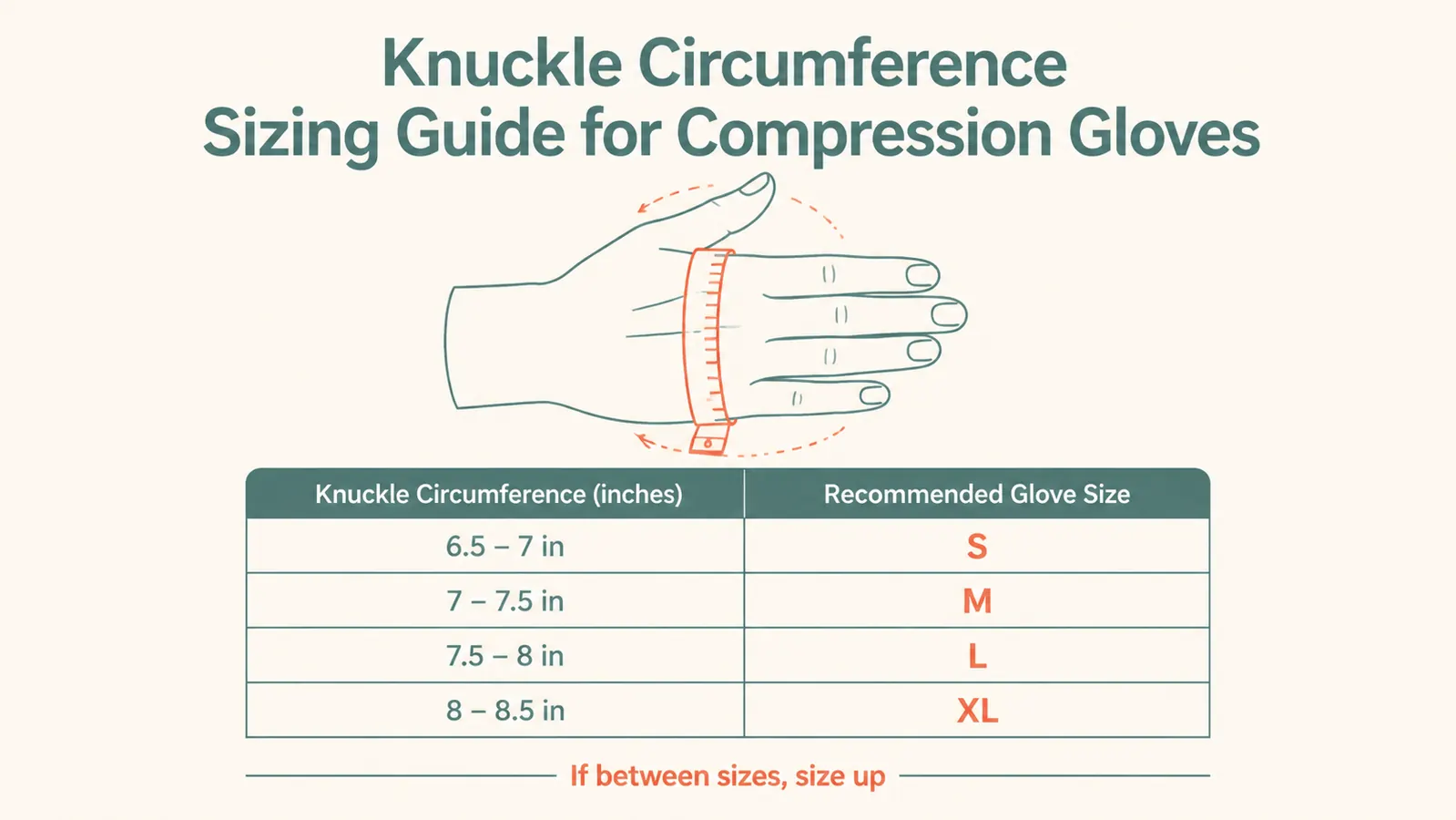
The Vive size chart tells you to measure the circumference of your hand at the widest part below the knuckles. The problem is that RA hands often have joint swelling at and above the knuckles, which means the widest part of your hand is at or above the knuckle row, not below it. If you measure where the chart tells you, you will probably land in a size that is technically correct for your hand shape but that digs into your swollen joints and reduces circulation instead of improving it.
The better approach: measure your knuckle circumference specifically, wrapping the tape around the widest part of your knuckles when your hand is in a loose fist. Then take that number and go one size up from what the chart recommends. If the chart says L, buy XL. I measured as a medium the first time I ordered. The gloves arrived and I could not get them over my knuckles without my fingers going white. I reordered in large. They fit correctly. This is the single most important thing I can tell you about buying these gloves.
Measure your knuckle circumference with your hand in a loose fist, then order one size larger than the chart says. This one step fixes the majority of fit complaints in RA hands.
The Riding-Up Problem and the Workaround
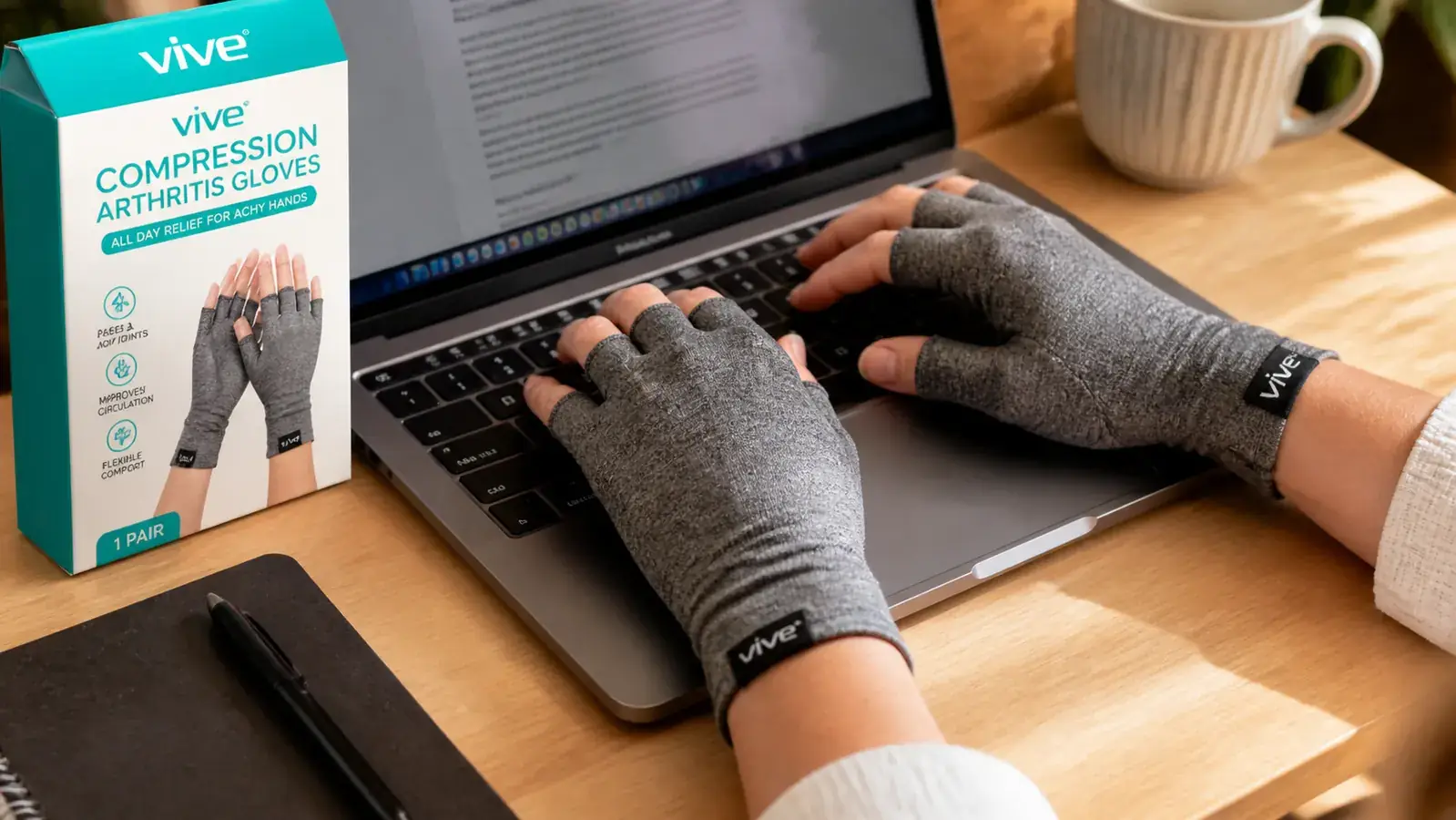
The cuffs of the Vive gloves stop about an inch or so above the wrist. During typing, the natural motion of your hands pulls the cuff upward toward your forearm. Within 20 to 30 minutes of sustained keyboard work, the cuff will have migrated far enough that you can feel it bunching under your sleeve or digging into your lower forearm unevenly. It's not painful, but it's distracting and it changes the compression distribution.
The workaround is simple: every 30 minutes, pull the cuffs back down. It takes three seconds. But I wish someone had told me to expect it because the first few times I noticed it I assumed I had bought the wrong size or that the gloves were defective. They're not. It's just how short-cuff compression gloves behave during repetitive motion. If the riding-up issue bothers you consistently, look for the longer-cuff version that extends further up the forearm. Some brands offer this; the Vive standard version does not. The IMAK Arthritis Glove has a longer wrist extension that some people find solves this problem, though the trade-off is that IMAK is bulkier and less suited for detailed finger work.
When These Gloves Are Not Enough
I want to be direct about this because I have seen people in RA forums asking whether compression gloves will help them through a severe flare, and the answer is no. If your hands are acutely inflamed, hot, visibly swollen, and every movement is painful rather than just stiff and effortful, a compression glove is not the right tool. The compression that feels supportive during moderate symptoms feels restrictive and irritating over an actively inflamed joint. On those days you want ice or gentle heat, rest, and whatever your rheumatologist has prescribed for flare management.
These gloves are also not a substitute for a custom OT-prescribed splint if your occupational therapist has given you one. The compression glove does not immobilize anything. If you have been told you need positional support, especially at night or during specific tasks, a compression glove does not provide that. If you have significant finger deformity from longstanding RA, particularly swan-neck deformity or boutonniere deformity, the Vive gloves may not fit comfortably around the altered joint geometry. They are designed for early-to-moderate RA hands that retain roughly normal finger alignment.
One more specific group: if you have psoriasis on your hands alongside PsA, or eczema, the fabric on extended wear can cause skin irritation. The gloves are made from a spandex-nylon blend that breathes reasonably well, but any close-fitting fabric worn for hours on compromised skin will eventually cause a reaction. Check after the first few sessions. If you're seeing redness along the seam lines, the gloves may not be suitable for all-day wear for you specifically.
How They Compare to IMAK and Copper Fit
I have tried three brands seriously: Vive, IMAK, and Copper Fit. My honest comparison: Vive is the best option for typing and keyboard-heavy work because the cut keeps the fingers more free and the fabric is thinner, which means better tactile feel on keys. IMAK has less of the riding-up problem because the wrist section is longer and the fit is more structured, but the fabric is thicker and I find it awkward for detailed hand tasks. Copper Fit has the heaviest marketing and the weakest construction; the compression feels inconsistent within a few weeks of washing. None of these are medical-grade. All of them are useful at the right level of symptoms.
If your main use case is morning stiffness and computer work, Vive is the right choice if you size up and accept the riding-up reality. If you need more forearm coverage or hate having to pull a glove down every half hour, IMAK is worth considering even though it costs a bit more. There is no reason to pay copper-infused markup prices for compression that works the same way regardless of the fiber content.
Hygiene: Buy Two Pairs and Wash Every Three Days
This is one of those things the listing doesn't say and the reviews almost never mention: compression gloves get gross fast. You are wearing a form-fitting fabric layer over skin that is dealing with inflammation, and depending on what medications you are on, your sweat chemistry may be different than average. Methotrexate and some biologics change skin output. The Vive gloves pick up hand oil, lotion residue, and general daily grime quickly, and a dirty compression glove in contact with joints that may already have compromised skin around them is not a great combination.
The practical solution is to buy at least two pairs from the start. Wash them every three days, or whenever they feel tacky or damp. The Vive gloves are machine washable on a gentle cycle; air dry them because the dryer degrades the spandex faster. At roughly eight to nine dollars per pair, buying two is not a hardship. The real mistake is buying one pair, washing it infrequently because you are dependent on it every morning, and then wondering why the compression feels looser at two months than it did at two weeks.
Pros
- Measurably reduces morning stiffness in mild-to-moderate RA hands when sized correctly
- Thin enough for detailed hand tasks including typing and holding a pen
- Open-finger design preserves full use of fingertips for phones, keys, and fine motor work
- Priced low enough to buy multiple pairs and rotate daily
- Machine washable with easy care
Cons
- Sizing runs small: RA hands almost always need to go one size above the chart recommendation
- Open fingertips leave distal joints exposed to cold, which limits usefulness in cold environments
- Cuffs ride up the forearm during extended typing and need to be repositioned every 30 minutes
- Compression is not enough for acute flares, severe hand swelling, or nighttime rest symptoms
- Can irritate skin in people with hand psoriasis or eczema on extended daily wear
- Not suitable if you have significant finger deformity from longstanding RA
Who This Is For
These gloves are a good fit if your RA or early-onset OA is in the mild-to-moderate range, your main symptoms are morning stiffness and daytime hand fatigue rather than acute inflammatory episodes, and your primary use case is work at a computer or tasks requiring fine motor control. They are also a reasonable starting point if you have recently been diagnosed and want to try compression before investing in more expensive options. At this price, the cost of discovering they don't work for your specific symptom profile is low. If you have been told by an OT or rheumatologist that you need positional support, a custom splint, or rest orthoses, this article is not a substitute for that advice.

Who Should Skip It
Skip this specific product if you have severe hand swelling that changes daily, if you have visible finger deformity, if your worst symptoms are at night rather than in the morning, or if you run cold hands and work in cool environments where fingertip exposure is a consistent problem. Also skip if your OT has already prescribed something. And skip if skin irritation is a concern: the fabric is fine for most people but the seam placement and fabric density will bother some PsA hands with active skin involvement. For a deeper discussion of when gloves are the right choice versus when a hand splint is what you actually need, see our full comparison piece on compression gloves vs hand splints for RA.
If morning stiffness is why you're here, they're worth trying at this price.
The Vive Compression Arthritis Gloves work for the right symptoms. Size up one size from the chart, buy two pairs, and wear them through the first two hours of your morning before you decide. That is the honest test.
Amazon Check Today's Price on Amazon →